
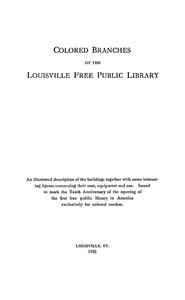
Colored Branches of the Louisville Free Public Library
Okay, let's clear something up first. This isn't a fiction book with a plot in the traditional sense. It's a historical record, but don't let that make you think it's dry. The 'story' here is the real-life narrative of how the Louisville Free Public Library navigated the complex and painful era of racial segregation.
The Story
The book documents the creation and operation of the library's separate branches for African American patrons. It starts in a time when the main library doors weren't open to everyone. Instead of simply denying service, the library system established these dedicated branches. The book follows their journey: from their founding, often in neighborhoods that desperately needed them, to the daily work inside their walls. We see how these branches were staffed by trained Black librarians—professional, educated women who were pillars of their community. They didn't just check out books; they created reading programs, hosted community events, and fought to build robust collections that served their patrons' needs. The story continues through the challenges of underfunding and inequality, all the way to the eventual push for integration and the closing of these separate facilities. It's the biography of an institution within an institution.
Why You Should Read It
This book flipped my understanding of library history. I always thought of libraries as inherently neutral, always-open havens. This showed me their complicated past. What hit me hardest was the profound contradiction: these branches were a product of segregation, yet they became incredible forces for good. They were places of refuge and ambition. The librarians' dedication shines through—their work was an act of quiet, persistent rebellion. It made me think deeply about the spaces we take for granted today and the people who had to fight to create them. It's not an angry rant; it's a clear-eyed, factual account that lets the history speak for itself, and that's what makes it so compelling.
Final Verdict
Perfect for history buffs who enjoy social history from the ground up, for library lovers curious about the roots of their favorite institution, and for anyone interested in stories of community building. It's also a great, focused read for anyone starting to explore America's complex history with civil rights. You'll come away with a newfound respect for librarians and a deeper understanding of how knowledge and access to it have always been at the heart of the struggle for equality.
This title is part of the public domain archive. It is now common property for all to enjoy.
Mary Martinez
3 months agoThis digital copy caught my eye due to its reputation, the practical checklists included are a great touch for real-world use. It definitely lives up to the reputation of the publisher.
James Wilson
6 months agoThought-provoking and well-organized content.
Donald Thomas
9 months agoBefore I started my latest project, I read this and the quality of the diagrams and illustrations (if applicable) is top-notch. This has become my go-to guide for this specific topic.
Barbara Rodriguez
8 months agoUnlike many other resources I've purchased before, the formatting on mobile devices is surprisingly crisp and clear. I'm glad I chose this over the other alternatives.




Margaret Anderson
11 months agoA brilliant read that I finished in one sitting.