
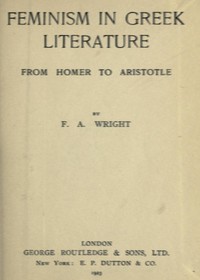
Feminism in Greek Literature from Homer to Aristotle by F. A. Wright
Let's be honest, when we think of ancient Greek literature, we picture heroes, gods, and epic battles. The women often feel like background characters, prizes to be won or causes for war. F. A. Wright's book flips that script entirely. He doesn't just retell the stories; he investigates them. He starts with Homer, pointing out how figures like Penelope and Helen have real agency and intelligence. Then, he follows the trail through later poets, playwrights, and historians, watching as the literary portrait of women gradually narrows.
The Story
There isn't a traditional plot, but there is a clear narrative arc. Wright acts as a guide, walking us through hundreds of years of writing. He shows us the strong, respected women in early epics and the complex, driving female characters in Athenian tragedy. Then, he brings us to the prose writers and philosophers like Plato and, finally, Aristotle. Here, the picture shifts. The arguments become more about women's 'natural' inferiority and their proper, confined place in the household. The book traces this intellectual and social shift, using the authors' own words to show how Greek society's idea of womanhood transformed.
Why You Should Read It
This book connects dots you didn't even know were there. After reading it, you can't look at a Greek myth the same way. You start asking different questions. Why is Medea so furious? What options did Penelope really have? It gives context to the frustrations of characters like Antigone. It's also a sharp reminder that ideas about gender aren't fixed; they have a history. Seeing how a culture's storytelling evolved to limit women's roles is both enlightening and a little unsettling. Wright, writing in the early 1900s, is clearly passionate about the subject, and that energy makes what could be a dry topic feel urgent and relevant.
Final Verdict
Perfect for anyone who loves Greek myths, history, or stories about how societies think. It's a great pick for book clubs that enjoy classics, as it will spark fantastic debate. You don't need a PhD to follow it, just curiosity. If you've ever read Homer or Sophocles and thought, 'But what about her?', this book is your answer. It's the missing commentary that makes the ancient world feel more complete, and honestly, more human.
This historical work is free of copyright protections. You can copy, modify, and distribute it freely.
Joseph Jackson
1 year agoI particularly value the technical accuracy maintained throughout.
Michael Perez
3 months agoComparing this to other titles in the same genre, the objective evaluation of the pros and cons is very refreshing. The price-to-value ratio here is simply unbeatable.
Barbara Rodriguez
9 months agoI was particularly interested in the case studies mentioned here, the data points used to support the main thesis are quite robust. A mandatory read for anyone in this industry.
Kimberly Lopez
2 months agoHaving explored several resources on this, I find that the evidence-based approach makes it a very credible source of information. Thanks for making such a high-quality version available.







David Harris
3 weeks agoThe clarity of the introduction set high expectations, and the chapter on advanced strategies offers insights I haven't seen elsewhere. I'll be citing this in my upcoming project.