
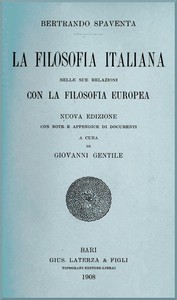
La filosofia italiana nelle sue relazioni con la filosofia europea by Spaventa
Let's be clear from the start: this isn't a novel. There's no plot in the traditional sense. But there is a powerful story being told. Bertrando Spaventa's "La filosofia italiana nelle sue relazioni con la filosofia europea" (Italian Philosophy in its Relations with European Philosophy) is the story of an idea fighting for recognition.
The Story
Spaventa, writing in the 19th century, saw a problem. In the grand narrative of European philosophy, Italy was often treated as a footnote after the Renaissance. The big action seemed to happen in Germany, France, and Britain. Spaventa pushes back hard against this. His book is a detailed, scholarly effort to trace the lines of thought from Italian philosophers—like Vico, Bruno, and Campanella—directly into the work of the major European thinkers who came later. He argues that ideas didn't just stop at the Alps; they traveled, evolved, and were essential. The "story" is his journey of reconnection, showing how Italian thought was not isolated but was a vital, circulating part of the European intellectual bloodstream.
Why You Should Read It
What grabbed me was the sheer force of Spaventa's conviction. You can feel his frustration and his pride. This is more than history; it's an act of cultural reclamation written during the Italian unification period (the Risorgimento). He's not just cataloging old books; he's building a case for Italy's modern intellectual identity. Reading it, you start to see philosophy not as a series of isolated geniuses, but as a messy, interconnected conversation across borders. It challenges the default map we have in our heads about where important ideas come from. While some parts are dense (it *is* a 19th-century academic text), the core argument is compelling and surprisingly relevant today, as we rethink which voices and traditions get centered in our histories.
Final Verdict
This book is a specialized pick, but a rewarding one. It's perfect for history or philosophy enthusiasts who already have a basic map of European thought and want to see it redrawn. If you've ever read Hegel or Kant and wondered about influences from the south, Spaventa has answers. It's also great for anyone interested in how nations construct their intellectual heritage. It's not a light introduction, but for the right reader, it's a key that unlocks a different understanding of Europe's shared mind.
Christopher Hill
1 year agoFive stars!
David Flores
1 year agoSurprisingly enough, the storytelling feels authentic and emotionally grounded. Exactly what I needed.
Emma King
1 year agoFive stars!
George Robinson
6 months agoTo be perfectly clear, the plot twists are genuinely surprising. Worth every second.





Donald Lewis
4 months agoAs someone who reads a lot, the character development leaves a lasting impact. I learned so much from this.