1

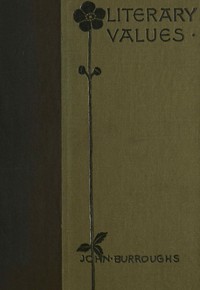
Literary values, and other papers — Themes and Context
(0 User reviews)
1207
Project Gutenberg
2024
Not confirmed
Literature -- History and criticism; American essays
Readers of public-domain and historical texts
Project Gutenberg digital edition
en
Edition facts
Words
72,170
Reading time
314 min
Text sections
23
Before opening Literary values, and other papers — Themes and Context, the edition data offers a quick orientation: 72,170 words, 5 hr 14 min estimated reading time, and 23 detected text sections.
The text analysis averages about 21.5 words per sentence, while the detected sections provide another way to judge how the source is divided.
Project Gutenberg metadata also associates the work with “Literature -- History and criticism,” connecting these edition facts with the source record’s subject description.
Source:
Project Gutenberg record #74104
John Burroughs examines literary judgment, style, and the tension between universal art and personal bias, drawing on Emerson, Whitman, Poe, and others to argue for disinterested reading and the relativity of aesthetic value.
Editorial Edition Score
4.8/5
★★★★★
★★★★★
Calculated from edition completeness, EPUB availability, text structure and catalogue metadata. Not a user rating.
How this score is calculated
- Description quality20 pts
- Title & short description10 pts
- Source metadata20 pts
- Text length15 pts
- Chapters / structure15 pts
- EPUB file integrity20 pts
Total of 100 points, scaled to a 2.5-5.0 range. Editions with an empty description or a missing EPUB file are not scored.
Edition quality
Public-domain source text
Read the source text
The source text is kept in the dedicated reader, separate from this catalogue record and its commentary.
John Burroughs opens this collection of essays by confronting the fate of writers after their deaths, when "no new work from his pen can call attention to him afresh." The question of how literary reputations endure—how they fare with figures like Lowell, Longfellow, Whittier, and Emerson—sets the stage for a sustained inquiry into what constitutes lasting value in literature. Burroughs writes as a naturalist and critic, blending a scientist's observational habit with a moralist's concern for sincerity and proportion.
The Disinterested Reader and the Perils of Fandom
Burroughs divides readers and writers into two camps: the interested and the disinterested. The former seek personal or special ends; the latter pursue general, universal ones. He warns against literary infatuation, arguing that "infatuation is not permissible in literature" and that art must make us "free of the whole." The essay cites Emerson's approving quotation of Shakespeare—"Read what you most affect"—but counters that broad culture demands vigilance against narrow predilections. Burroughs critiques Browning devotees and Whitman disciples who make a cult of their master, noting Whitman himself taught that "the chief lesson to be learned under the master is how to destroy him." This tension between passionate attachment and critical distance runs through the volume.
Poe, Tennyson, and the Ubiquity of True Art
Burroughs argues that Poe outranks the New England poets in the eyes of foreign critics because his work possesses "the ubiquitous character of true art," less pledged to moral or special ends. He calls Poe "a conjurer with words" who used language for its music, citing "The Raven" and "The Bells" as examples of "play, that scorn of personal ends, that potential spiritual energy." By contrast, Tennyson is praised for having "the artist nature in greater measure than Wordsworth," a more flexible receptive spirit that harvests the experiences of other men, not just his own. Burroughs's diction—"ubiquitous," "unpledged æsthetic nature"—reveals his preference for art that transcends the merely personal.
The Relativity of Aesthetic Judgment
Burroughs identifies "the perception of relativity" as one of the latest and most mature perceptions in art. He illustrates this by comparing Longfellow and Whittier: Longfellow's Muse is less in the service of special ideas, less Quaker and Puritan, and therefore finds "a wider and more disinterested audience." The essay also contrasts Gray's "Elegy," filled with "the breadth of universal human life," with Schiller's "Robbers" and Goethe's "Werther," which now seem like "an empty shell picked up on the shore." Burroughs's imagery—shells, shores, fountains—draws on his naturalist's vocabulary, grounding abstract literary theory in concrete, physical metaphors.
Style, Sincerity, and the Writer's Voice
Throughout the collection, Burroughs returns to the relationship between style and the man. He insists that the creative touch marks the artist: "He smites the rocks, and a fountain gushes forth." The essays examine how individual convictions shape or distort literary expression. Burroughs praises disinterestedness not as coldness but as a kind of artistic health that "consoles, not as the priest consoles, but as love and life themselves do." His own prose is measured, aphoristic, and occasionally blunt—he calls Poe's "Annabel Lee" vague and shadowy, its content "as vague and shadowy as its angels and demons." This willingness to judge sharply, yet without malice, gives the criticism a bracing clarity.
Burroughs's essays reward readers who enjoy watching a disciplined mind work through problems of taste and permanence. He does not offer a system but a series of provocations, each grounded in specific examples and a naturalist's eye for proportion. The collection is best approached as a conversation with a thoughtful, occasionally crotchety guide—one who expects you to disagree, but to do so with evidence and self-awareness.
Burroughs’s quiet insistence on honest, disinterested reading reminded me of an afternoon spent rereading Stevenson’s essays on craft. There, too, the writer’s own verdicts waver, caught between what we love and what we judge. The same gentle struggle between taste and truth lingers in both, like a familiar voice I’d almost forgotten. Essays in the Art of Writing — Context and Discussion feels like its whispered sequel.
There are no reviews for this eBook.
There are no comments for this eBook.
Reader reflection
Your personal reading reflection
Build a private reading journal entry for this title.
Your progress
0
/
10
2
Was reading this book enjoyable?
3
Is this a title you would suggest to others?
4
How much effort did this book require?
5
Did the book offer a fresh perspective?
6
Did any part of the book stay with you emotionally?
7
Did you relate to its people, ideas, or situations?
8
Did the story or argument move comfortably?
9
Which lesson or insight stayed with you?
10