
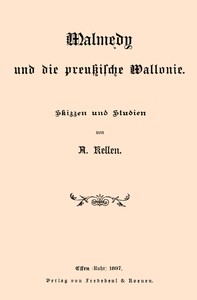
Malmedy und die preußische Wallonie : Skizzen und Studien by Tony Kellen
Tony Kellen's Malmedy und die preußische Wallonie is a book from another time, but it tackles a question that feels very modern: what happens to a place when it doesn't fit neatly on a map?
The Story
This isn't a novel with a plot, but a journey of discovery. Kellen, writing in the early 20th century, takes us to Malmedy and the surrounding "Prussian Wallonia." For centuries, this area was ruled by Prussia (and later Germany), even though many of its people spoke a Romance language related to French. The book is a series of observations – think of them as detailed blog posts from 1906. He examines everything: the mix of German and French on shop signs, the local legends, the shape of the farmhouses, and the complicated feelings of the people living there. The central thread is his attempt to understand this cultural puzzle. Is this land fundamentally German territory with a French twist, or a Walloon region under German administration? The tension of that question is the real story.
Why You Should Read It
What grabbed me was the book's intimate, ground-level view. This isn't about kings and treaties; it's about what language kids speak in the schoolyard and how holidays are celebrated. Kellen doesn't just give you dates; he tries to give you the feel of a borderland. Reading it today, with our own debates about nationalism and regional identity, is surprisingly relevant. You see how politics from a capital city far away can ripple through daily life in a small town. It’s also a snapshot of a world about to vanish. Kellen was writing just before World War I, which would completely redraw the maps and destinies of places like Malmedy. There's a quiet urgency in his writing, a sense that he's documenting a way of life that might not last.
Final Verdict
This book is a specialist's treasure, but curious general readers can find gold here too. It's perfect for history buffs who enjoy micro-history and stories of European regions like Alsace or Silesia. If you're fascinated by linguistics or cultural anthropology, Kellen's on-the-ground notes are a great primary source. A fair warning: it's an old, academic text, so the pace is thoughtful, not fast. But if you have the patience, it offers a profound look at how ordinary people navigate the big, messy forces of history and identity. It’s less of a page-turner and more of a thoughtful conversation with the past.
This title is part of the public domain archive. It is now common property for all to enjoy.
Matthew Thompson
4 months agoIt effectively synthesizes complex ideas into a coherent whole.
John Gonzalez
1 month agoI wanted to compare this perspective with traditional views, the chapter on advanced strategies offers insights I haven't seen elsewhere. A trustworthy resource that I'll keep in my digital library.
Jennifer Taylor
3 weeks agoA sophisticated analysis that fills a gap in the literature.
Nancy Rodriguez
6 months agoInitially, I was looking for a specific answer, but the narrative arc keeps the reader engaged while delivering factual content. Highly recommended for those seeking credible information.
Thomas Thompson
1 month agoVery satisfied with the depth of this material.