1

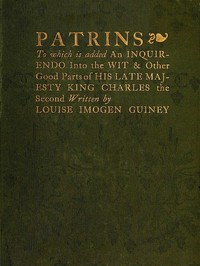
Patrins To Which Is Added an Inquirendo Into the Wit & Other Good Parts of His Late Majesty King Charles the Second — Inside the Classic
(0 User reviews)
451
Project Gutenberg
2018
Not confirmed
Charles II, King of England, 1630-1685; American essays -- 19th century
Readers of public-domain and historical texts
Project Gutenberg digital edition
en
Edition facts
Words
55,031
Reading time
240 min
Text sections
7
The catalog record for Patrins To Which Is Added an Inquirendo Into the Wit & Other Good Parts of His Late Majesty King Charles the Second — Inside the Classic provides practical reading context through 55,031 words, 4 hr estimated reading time, and 7 detected text sections.
The text analysis averages about 23.2 words per sentence, while the detected sections provide another way to judge how the source is divided.
Project Gutenberg metadata also associates the work with “Charles II, King of England, 1630-1685,” connecting these edition facts with the source record’s subject description.
Source:
Project Gutenberg record #57024
A collection of essays by Louise Imogen Guiney, blending literary criticism, personal reflection, and historical inquiry, including a lengthy examination of King Charles II's wit. The catalog subjects 'American essays' and 'Charles II' only partially capture the work's eclectic, essayistic range.
Editorial Edition Score
4.7/5
★★★★★
★★★★★
Calculated from edition completeness, EPUB availability, text structure and catalogue metadata. Not a user rating.
How this score is calculated
- Description quality20 pts
- Title & short description10 pts
- Source metadata20 pts
- Text length15 pts
- Chapters / structure15 pts
- EPUB file integrity20 pts
Total of 100 points, scaled to a 2.5-5.0 range. Editions with an empty description or a missing EPUB file are not scored.
Edition quality
Public-domain source text
Read the source text
The source text is kept in the dedicated reader, separate from this catalogue record and its commentary.
The title Patrins is glossed in the dedication as a Gypsy trail: 'handfuls of leaves or grass cast by the Gypsies on the road, to denote, to those behind, the way which they have taken.' Guiney applies this metaphor to her own essays, calling them 'wild dry whims' dropped for her tribe. The collection opens with a philosophical piece on the 'rabid versus the harmless scholar,' where she argues that students and artists in their 'crude transitional state' should be hidden from public view, much like rough drafts of a painter. This sets a tone of contrarian, learned reflection that runs through the volume.
The Scholar as Unfinished Creature
In the opening essay, Guiney compares the visibility of children in Paris to that of students, whom she calls 'in a crude transitional state, and undergoing a growth much more distressing to a sensitive observer than the physical.' She extends the analogy to artists and poets, arguing that their rough first drafts ought to remain concealed. The essay draws on a philosopher who wished to 'shut up everything under ten years of age,' a remark Guiney calls 'the remark of an artist in human affairs.' She then pivots to the idea that the spiritual man is 'possessed of a divine indolence,' citing Arthur Hugh Clough as an 'expert in inaction.' The essay concludes that artists and thinkers are 'the protest which counts,' and that success is to them 'a thing foregone.'
Quiet London and the Sound of Silence
The essay 'Quiet London' offers a counterintuitive portrait of the city, emphasizing its 'strange whispers, meek undertones' rather than its noise. Guiney contrasts London with Paris, calling the parallel 'next weariest, in the scale of human comparisons, to that between D——s and T——y.' She describes the 'monstrous awe-engendering institution like the 'bus' as 'almost as deft and as still as a humming-bird.' The essay suggests that the city's instructed inhabitant knows it by its silences, not its clamor. This piece exemplifies Guiney's tendency to find the unexpected in familiar subjects, using precise sensory detail to overturn common assumptions.
The Inquirendo into Charles II
The final and longest piece, 'An Inquirendo into the Wit and Other Good Parts of His Late Majesty, King Charles the Second,' occupies a substantial portion of the volume. Though the catalog subject lists Charles II, the essay is not a biography but a character study focused on the king's wit and personal qualities. Guiney approaches her subject with a blend of historical curiosity and literary analysis, examining anecdotes and reputations. The essay's title itself signals a playful, investigative tone—'Inquirendo' suggesting a legal or formal inquiry. Based on the excerpts, the piece likely draws on seventeenth-century sources to reconstruct the king's conversational style and charm, though the full argument remains incomplete in the provided text.
Readers approaching Patrins should expect a miscellany of essays that resist easy categorization. Guiney moves from scholarly paradox to urban observation to historical portraiture, often within a single paragraph. The catalog labels 'American essays' and 'Charles II' only hint at the range; the book is better understood as a collection of intellectual curiosities, each essay a 'patrin' marking a path through the author's thought-country. Those interested in late nineteenth-century American essayists, or in the essay form as a vehicle for wit and learning, will find much to savor.
That rainy afternoon, Guiney’s meddling with King Charles’s wit felt less like scholarship than a cozy, private jest. It left me craving that same unhurried, companionable tone, so I reached for This and That and the Other — A Reader’s Guide, and found a kindred, rambling spirit. The rain never stopped; neither did the pleasant digressions.
There are no reviews for this eBook.
There are no comments for this eBook.
Reader reflection
How did this book work for you?
Your answers remain private and are stored only in this browser.
Your progress
0
/
10
2
How did the book work for you overall?
3
Is this a title you would suggest to others?
4
How much effort did this book require?
5
Could you see yourself revisiting this book?
6
Did the book give you something worth debating?
7
Was the book moving at the right speed?
8
Did the book offer a fresh perspective?
9
What changed or sharpened your thinking?
10