1

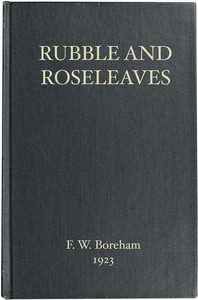
Rubble and Roseleaves, and Things of That Kind — A Closer Reading
(0 User reviews)
2350
Project Gutenberg
2019
Not confirmed
Essays; Christian life -- Baptist authors
Readers of public-domain and historical texts
Project Gutenberg digital edition
en
Edition facts
Words
59,831
Reading time
261 min
Text sections
7
This digital edition of Rubble and Roseleaves, and Things of That Kind — A Closer Reading is described by source-level measurements including 59,831 words, 4 hr 21 min estimated reading time, and 7 detected text sections.
The text analysis averages about 17.8 words per sentence, while the detected sections provide another way to judge how the source is divided.
Project Gutenberg metadata also associates the work with “Essays,” connecting these edition facts with the source record’s subject description.
Source:
Project Gutenberg record #59180
Frank Boreham's collection of 21 essays, each sparked by everyday objects and memories, explores the extraordinary within the ordinary through a conversational, self-deprecating voice that blends autobiography, reflection, and gentle moral insight.
Editorial Edition Score
4.7/5
★★★★★
★★★★★
Calculated from edition completeness, EPUB availability, text structure and catalogue metadata. Not a user rating.
How this score is calculated
- Description quality20 pts
- Title & short description10 pts
- Source metadata20 pts
- Text length15 pts
- Chapters / structure15 pts
- EPUB file integrity20 pts
Total of 100 points, scaled to a 2.5-5.0 range. Editions with an empty description or a missing EPUB file are not scored.
Edition quality
Public-domain source text
Read the source text
The source text is kept in the dedicated reader, separate from this catalogue record and its commentary.
Frank Boreham opens his introduction by confessing a genius for a comfortable armchair and a blazing fire, and he frames Rubble and Roseleaves as a series of wayward notions set down after long silences—silences he says are represented by the gaps between chapters. The essays themselves begin with concrete, often humble objects: three torn envelopes in a waste-paper basket, a green chair, old photographs, a box of blocks. Boreham’s prose moves from these tangible starting points into reflection, anecdote, and quiet philosophy, never losing the intimate, spoken quality he establishes from the first page.
The Voice of the Armchair
Boreham’s authorial voice is deliberately informal, even self-mocking. He calls his introduction an “outrageous spasm of autobiography” and insists his pieces are neither essays nor sermons. This conversational tone is sustained throughout: in “Old Envelopes,” he imagines the envelopes speaking reproachfully, and he addresses them directly. The diction is plain but precise—words like “yawning abyss” and “plaintive voice” give personality to stationery. Boreham often uses rhetorical questions and direct address, as when he asks, “Isn’t an envelope as good as a letter any day?” This technique creates the feeling of a fireside monologue, where the reader is a companion rather than a student.
Saturday’s Two Glories
In the essay “Saturday,” Boreham distinguishes between the glory of Saturday’s dawn and the glory of its dusk: one like a Red Indian shouting a war-whoop, the other like a monk chanting an evening hymn. The simile is characteristic—he draws on vivid, varied imagery to capture a child’s experience. He recalls his schoolmaster’s etymology linking Saturday to Saturn’s rings, and how he confused that with the nursery-rhyme lady who has rings on her fingers and bells on her toes. The passage shows Boreham’s method: he takes a small fact or memory, lets it accrue associations, and builds a layered reflection on time, memory, and the texture of ordinary life.
The Risk of Sending Manuscripts
Boreham describes the anxiety of sending white sheets of manuscript six hundred miles to a printer, thinking of all the hands they must pass through, the risk of fire or accident. He writes that seeing his work in print feels like securing it beyond reach of harm: “If this house is burned down, I can obtain a copy in that one!” The passage reveals his awareness of the fragility of creative work and the paradox that to keep a thing you must throw it away—a theme he develops with the example of Achmed Ali scattering grain. This concrete, personal anecdote grounds a broader reflection on letting go, trust, and the material life of writing.
Objects That Speak
Throughout the collection, Boreham animates everyday objects: envelopes, a green chair, old photographs, a box of blocks. In “Old Envelopes,” the envelopes are given distinct personalities—a heavy pompous one, a thin blue one barking about an unpaid account, a dainty perfumed one asking if chivalry is dead. This personification is not mere whimsy; it serves as a device to explore gratitude, neglect, and the hidden stories in discarded things. Boreham’s descriptions are economical but evocative: the envelopes are “cruelly torn and sadly crumpled,” looking up from the waste-paper basket. The effect is to make the reader see the familiar anew, and to suggest that even rubble can yield roseleaves.
Boreham’s essays reward a slow, attentive reading. Because each piece begins with a specific object or memory, readers may choose to dip in at any point rather than read straight through. The gaps between chapters—those silences Boreham mentions—invite pause. Pay attention to the way he builds from a single image into a wider meditation; the movement from envelope to apology, from Saturday to Saturn’s rings, is the heart of his craft.
There’s a moment in Rubble and Roseleaves where Boreham makes you feel like he’s just remembered something—and then lets you in on it. That same unhurried trust lives quietly in Caper-Sauce: A Volume of Chit-Chat about Men, Women, and Things. — A Closer Reading, as if he’s still sorting through old drawers, finding small truths in the dust. I keep coming back to that gentleness.
There are no reviews for this eBook.
There are no comments for this eBook.
Reader reflection
How will you remember this book?
Save your reaction, strongest insight, and memorable passage.
Your progress
0
/
10
2
Was reading this book enjoyable?
3
Would you recommend this book to another reader?
4
How demanding did the text feel?
5
Did the book give you something worth debating?
6
What was its emotional impact?
7
Was the book easy to understand?
8
How did the reading compare with what you expected?
9
What changed or sharpened your thinking?
10