1

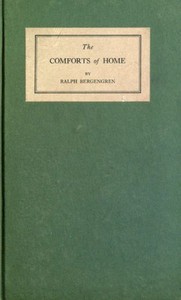
The Comforts of Home — A Reader’s Guide
(0 User reviews)
1220
Project Gutenberg
2011
Not confirmed
Essays
Readers of public-domain and historical texts
Project Gutenberg digital edition
en
Edition facts
Words
18,308
Reading time
80 min
Text sections
2
The source record for The Comforts of Home — A Reader’s Guide measures this digital text at 18,308 words, 1 hr 20 min estimated reading time, and 2 detected text sections.
The text analysis averages about 23.2 words per sentence, while the detected sections provide another way to judge how the source is divided.
Project Gutenberg metadata also associates the work with “Essays,” connecting these edition facts with the source record’s subject description.
Source:
Project Gutenberg record #37017
Ralph Bergengren's 1918 essay collection humorously examines domestic life through the lens of a new old house, blending lease anxieties, kitchen history, and the absurdities of modern convenience with a wry, conversational voice.
Editorial Edition Score
4.5/5
★★★★★
★★★★★
Calculated from edition completeness, EPUB availability, text structure and catalogue metadata. Not a user rating.
How this score is calculated
- Description quality20 pts
- Title & short description10 pts
- Source metadata20 pts
- Text length15 pts
- Chapters / structure15 pts
- EPUB file integrity20 pts
Total of 100 points, scaled to a 2.5-5.0 range. Editions with an empty description or a missing EPUB file are not scored.
Edition quality
Public-domain source text
Read the source text
The source text is kept in the dedicated reader, separate from this catalogue record and its commentary.
Ralph Bergengren opens The Comforts of Home with a lease—a document he treats as a comic portrait of suspicion, where the lessor is a benevolent despot and the lessee a worm with criminal tendencies. This sets the tone for a collection that finds humor in the mundane details of early twentieth-century domesticity. Bergengren’s narrator moves through rooms with a keen eye for the absurd: the hundred-year-old chimney that welcomes flies, the impossibly steep cellar stairs, and the legal prohibition against drilling holes in stonework. The voice is genial but precise, mixing legal jargon with wry asides, and it establishes a rhythm of observation that carries through the essays.
The Lease as Comic Prologue
Bergengren devotes the first essay to the lease, transforming a dry legal contract into a source of sustained comedy. He quotes its terms directly—no holes in stonework, no piggery in the cellar—and then imagines the lessor’s view of the tenant as a potential criminal. The narrator’s tone is that of a man who has read his lease too carefully and now sees menace in every clause. This opening gambit establishes a pattern: the author takes a prosaic object (a lease, a furnace, a kitchen sink) and extracts its hidden drama. The lease becomes a microcosm of domestic anxiety, where the home is never fully one’s own. Bergengren’s humor relies on understatement and the precise rendering of bureaucratic language, which he then punctures with absurd hypotheticals.
Kitchen Time Travel
In the essay on kitchens, Bergengren traces the evolution from brick ovens to kitchenettes with a mix of nostalgia and bemusement. He recalls grandmothers smoking pipes by the fire and the advent of the coal range, which made earlier fireplaces obsolete. The tone shifts from comic to gently elegiac when he describes the modern kitchenette: a space so small that a man can bathe, shave, and cook breakfast simultaneously, stepping between tub and stove. Bergengren calls it a “Peter Pan of domestic institutions,” a baby kitchen that never grows up. He laments the loss of space and conversation, but his criticism is tempered by affection for the absurdity of the arrangement. The essay includes a short poem about a cook’s rest corner, which Bergengren presents without irony, suggesting a genuine appreciation for domestic comfort even as he mocks its modern forms.
Rhythm in the Bathroom
Bergengren’s prose often finds unexpected patterns in everyday life. In the kitchenette passage, he describes the “wild yet orderly beauty” of wet footprints between bath and stove, and he invokes the word “rhythm” to describe the choreography of morning routines. This attention to physical movement—the steps saved by efficient kitchen design, the back-and-forth of a multitasking cook—reveals a writer attuned to the body’s place in domestic space. The narrator is not merely an observer but a participant, humming a tune while shaving and turning toast. Bergengren’s voice here is conversational, almost confidential, as if sharing a private discovery. The effect is to make the reader see the familiar with fresh eyes, finding comedy and grace in the most ordinary actions.
Bergengren’s essays reward a slow reading that savors his precise diction and comic timing. The collection is best approached not as a practical guide but as a series of meditations on the quirks of home life, written in a voice that is both amused and affectionate. Readers may notice how the author’s tone shifts from legal parody to lyrical nostalgia within a single paragraph, and how his observations about space and efficiency anticipate later critiques of modern living. The humor is gentle but pointed, and the essays gain depth when read in sequence, as themes of comfort and inconvenience echo across chapters.
There’s a moment in The Comforts of Home where Bergengren makes peace with an old house’s quirks, and I felt that same quiet acceptance elsewhere—in a slim volume about what it means to carry oneself with grace through imperfection. That other book, The Perfect Gentleman — Key Ideas to Explore, lingers with me like a familiar chair. We age, and so does our understanding of home.
There are no reviews for this eBook.
There are no comments for this eBook.
Reader reflection
How will you remember this book?
Save your reaction, strongest insight, and memorable passage.
Your progress
0
/
10
2
How did the book work for you overall?
3
Would you encourage someone else to read it?
4
Did the language feel accessible?
5
How personally connected did you feel to the book?
6
How did the reading compare with what you expected?
7
Could you apply anything you learned?
8
How strongly did the book affect you emotionally?
9
In one sentence, what did you learn?
10