
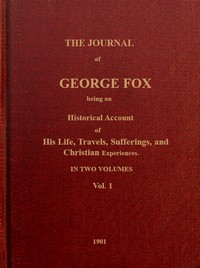
The journal of George Fox, vol. 1 of 2 : Being an historical account of his…
Okay, let's set the scene: England, mid-1600s. The country is a mess—civil war, king vs. parliament, and about a hundred different people arguing about the 'right' way to worship. Into this chaos walks George Fox, a young man from a humble background, deeply troubled by the hypocrisy he sees in the established church. He doesn't go to university. He doesn't get ordained. Instead, he has a series of powerful personal experiences that convince him that real faith doesn't need priests, fancy buildings, or rituals. It needs what he calls the 'Inner Light' of Christ shining directly in every person.
The Story
This journal is Fox telling his own story, from his restless youth to becoming the founder of the Quakers (or the Religious Society of Friends). Volume 1 covers the explosive early years. We travel with him as he walks from town to village, often barefoot, preaching in market squares and, famously, interrupting church services to challenge the ministers. The 'plot' is a series of confrontations: with authorities who jail him, with angry crowds who beat him, and with theologians who try to debate him. Through it all, Fox writes with a calm, stubborn certainty. He details his time in filthy, freezing prisons not as tragedies, but as tests of faith. The narrative is less about a linear journey and more about the birth of a radical idea—that anyone, from a milkmaid to a general, could connect with God without a middleman.
Why You Should Read It
You should read this not because it's an easy, relaxing biography. It's not. Fox's writing can be repetitive and his certainty is absolute, which is both his superpower and what makes him a difficult character sometimes. You read it for the raw, unfiltered voice. This isn't a historian's polished take on the Quaker movement; it's the founder's live commentary. You feel his frustration, his physical suffering in prison, and his genuine wonder when he sees his message click for someone. The themes are huge—conscience vs. authority, the cost of nonconformity, and the search for authentic spiritual experience—but they're grounded in the mud of English roads and the damp straw of a prison cell. It makes history feel immediate and personal.
Final Verdict
This book is perfect for anyone fascinated by radical history, the origins of social movements, or intense spiritual autobiographies. If you like stories about underdogs who refuse to bend, you'll find Fox compelling. It's also a goldmine for understanding pacifism and civil disobedience; you see the blueprint right here. A word of caution: it's a primary source, so it requires a bit of patience. But if you stick with it, you're not just reading about history—you're hearing its voice, in all its challenging, inspiring, and uncompromising glory.
This text is dedicated to the public domain. It is available for public use and education.
Kimberly Martin
5 months agoHaving read this twice, the author's voice is distinct and makes complex topics easy to digest. I will read more from this author.
George Miller
1 year agoFinally found time to read this!
Noah Harris
1 year agoI had low expectations initially, however the narrative structure is incredibly compelling. I couldn't put it down.









Mark Flores
1 year agoI had low expectations initially, however the narrative structure is incredibly compelling. Thanks for sharing this review.