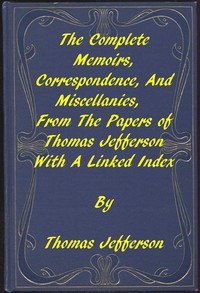
The Memoirs, Correspondence, and Miscellanies, From the Papers of Thomas Jefferson A Linked Index to the Project Gutenberg Editions — A Closer Reading

(4 User reviews)   1125
Jefferson, Thomas, 1743-1826, Randolph, Thomas Jefferson, 1792-1875 [Editor], Widger, David, 1932-2021 [Editor] Project Gutenberg 2009
United States -- Politics and government -- 1775-1783; United States -- Politics and government -- 1783-1865 Readers of public-domain and historical texts
Project Gutenberg digital edition en

Edition facts

Words: 881,241
Reading time: 3832 min
Text sections: 113
An editorial note on Thomas Jefferson's collected papers, examining his diplomatic correspondence and memoir through diction, voice, and structural choices, with specific observations on phrasing and rhetorical patterns.
Share
Editorial Edition Score 4.9/5

Calculated from edition completeness, EPUB availability, text structure and catalogue metadata. Not a user rating.

Edition quality

Thomas Jefferson's collected papers, as edited by his grandson Thomas Jefferson Randolph and later indexed by David Widger, present a distinctive authorial voice shaped by the demands of eighteenth-century diplomatic correspondence. The letters reveal a writer who balances formal address with precise observation, as when he notes that the French guards' dissensions 'occasioned some private combats, in which five or six were killed'—a terse, almost clinical phrasing that avoids embellishment. Jefferson's diction often carries a measured urgency, particularly in passages describing political instability, such as his remark that 'the want of bread for some days past has greatly endangered the peace of the city.' These choices reflect a mind attuned to both detail and consequence.

Diction and the Diplomatic Register

Jefferson's vocabulary in these letters oscillates between the formal and the conversational, a register that marks his awareness of audience. In a letter to James Madison, he uses the phrase 'palpable impotence of the city administration'—the word 'palpable' lending a tactile quality to his critique, while 'impotence' carries a legal and political weight. Elsewhere, he adopts a more direct, almost colloquial tone: 'Never was there a country where the practice of governing too much, had taken deeper root and done more mischief.' The repetition of 'too much' and the emphatic 'never' create a rhetorical punch that stands out against the surrounding decorum. These shifts in diction are not random; they signal moments of personal conviction or frustration, offering a window into Jefferson's private judgments even as he maintains official courtesy.

Voice and the Construction of Authority

Jefferson's authorial voice in these papers is built through a careful balance of deference and assertion. He frequently apologizes for his inquiries, as when he writes to the Count de Montmorin: 'I apologized to him for the inquiries I had made into this business, by observing that it would be much against our interest.' Yet the apology itself frames a substantive geopolitical argument. This pattern—hedging followed by pointed analysis—recurs throughout the correspondence. In the memoir sections, the voice shifts to a more retrospective, explanatory tone, as when Jefferson recounts that 'the government had never such an idea; but that the story was not without foundation altogether.' The double negative and the qualifying 'altogether' reveal a writer who weighs evidence carefully, unwilling to commit to a single interpretation. This cautious, layered voice is a hallmark of Jefferson's prose in these documents.

Structural Patterns in the Correspondence

The organization of Jefferson's letters follows a consistent structural pattern that reinforces his rhetorical goals. Many open with a salutation and a brief acknowledgment of previous correspondence—'My last to you was of July the 22nd. Since that, I have received yours of May the 27th'—establishing a chain of communication. The body then moves from general news (e.g., 'The tranquillity of the city has not been disturbed since my last') to specific incidents, and finally to analysis or policy recommendations. This tripartite structure—acknowledgment, report, reflection—allows Jefferson to build credibility before advancing his own views. Notably, he often embeds his most critical observations within longer paragraphs, as if to soften their impact. The closing formula, 'I have the honor to be, with sentiments of the most perfect esteem and respect,' is a fixed element that contrasts with the sometimes sharp content preceding it, creating a tension between form and substance.

Recurring Details and Thematic Threads

Certain details recur across the correspondence, revealing Jefferson's preoccupations. The availability of bread in Paris appears as a barometer of political stability: 'The want of bread for some days past has greatly endangered the peace of the city.' He notes that 'the poor are the best served, because they besiege perpetually the doors of the bakers'—a vivid image that underscores social dynamics. Another recurring thread is the question of colonial emancipation, which Jefferson raises with Montmorin: 'The emancipation of their islands is an idea prevailing in the minds of several members of the National Assembly.' These repeated references suggest that Jefferson saw the French colonial situation as a mirror to American concerns. Additionally, his attention to procedural delays—'It was not till yesterday, that general leave was given to the bakers'—highlights a frustration with bureaucratic inefficiency that runs through many letters.

Readers approaching this collection should attend to the interplay between Jefferson's public role and his private judgments, as revealed through word choice and sentence structure. The letters reward close reading: a single adverb or a shift in tense can signal a shift in stance. Because the excerpts are incomplete, any broader claims about character or narrative arc must remain tentative. However, the patterns of diction, voice, and structure evident in these passages offer a reliable guide to Jefferson's authorial habits and rhetorical strategies.

William Miller
1 week ago

Joseph Thomas
2 weeks ago

Samuel Smith
3 weeks ago

Anthony White
1 week ago

4
4 out of 5 (4 User reviews )

Add a Review

Your Rating *
  • ...
    Dana Hardy - 2 weeks ago
    {'rating': 2, 'text': "The index is functional but the linked format feels dated. It lacks annotations and context, making it less useful for those unfamiliar with Jefferson. Also, navigation could be smoother. It's a basic tool, but not a scholarly edition."}

  • ...
    Benjamin Jones - 1 week ago
    {'rating': 4, 'text': "This linked index is an indispensable tool for navigating Jefferson's vast writings. It provides quick access to the Project Gutenberg editions, with clear organization and useful cross-references. The memoirs and letters offer profound insights into his mind and era. Highly recommended for historians and students, saving time and effort."}

  • ...
    Shawn Robinson - 4 days ago
    {'rating': 3, 'text': "An efficient index that fulfills its purpose, allowing easy location of specific documents. The content is of historical value, but the index is just that—an index, not a narrative. If you're looking for analysis, this isn't it. Still, for research, it's handy."}


Reader reflection

Your personal reading reflection

Build a private reading journal entry for this title.

Your progress 0 / 10
1

What is your current status with this title?

2

How did the book work for you overall?

3

Would you pass this book on to a friend?

4

What was the reading difficulty like?

Related eBooks