1

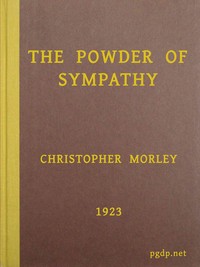
The Powder of Sympathy — Reading Companion
(0 User reviews)
1591
Project Gutenberg
2022
Not confirmed
American essays -- 20th century
Readers of public-domain and historical texts
Project Gutenberg digital edition
en
Edition facts
Words
76,875
Reading time
335 min
Text sections
48
For The Powder of Sympathy — Reading Companion, the stored edition analysis reports 76,875 words, 5 hr 35 min estimated reading time, and 48 detected text sections.
The text analysis averages about 20.4 words per sentence, while the detected sections provide another way to judge how the source is divided.
Project Gutenberg metadata also associates the work with “American essays -- 20th century,” connecting these edition facts with the source record’s subject description.
Source:
Project Gutenberg record #67188
Christopher Morley's 1923 collection of newspaper essays, framed by a fictional correspondence about a digestive-candy startup, blends literary musings, advertising satire, and urban observation with a playful, self-deprecating voice.
Editorial Edition Score
4.9/5
★★★★★
★★★★★
Calculated from edition completeness, EPUB availability, text structure and catalogue metadata. Not a user rating.
How this score is calculated
- Description quality20 pts
- Title & short description10 pts
- Source metadata20 pts
- Text length15 pts
- Chapters / structure15 pts
- EPUB file integrity20 pts
Total of 100 points, scaled to a 2.5-5.0 range. Editions with an empty description or a missing EPUB file are not scored.
Edition quality
Public-domain source text
Read the source text
The source text is kept in the dedicated reader, separate from this catalogue record and its commentary.
Christopher Morley's The Powder of Sympathy opens with a dedication that sets its tone: a book is a "frail and human emanation," and these pieces were written "out of the pressure and hilarity and contention of the mind." The title itself, borrowed from Sir Thomas Browne's term for a sympathetic powder, hints at a collection that aims to connect disparate thoughts. The first excerpt reveals a fictional correspondence between Nicholas Ribstone, president of the Ginger Cubes Corporation, and a nurse, Candida Cumnor, about a delirious advertising manager. This framing device—a business venture for "Digestive Dice"—introduces Morley's characteristic blend of whimsy and satire.
A Newspaperman's Scrapbook
The book's structure is openly episodic. Morley acknowledges its "ephemeral origin" in the dedication, noting the pieces were "almost all written for a newspaper." The excerpts show a range of subjects: a letter about a failed Tolstoy mailing list, a proposal for subway ads shaped like dice, and a nurse's report on a patient's delusions. This variety suggests the collection is less a unified narrative than a mosaic of observations, linked by Morley's consistent voice—wry, self-aware, and fond of digression. Readers should expect abrupt shifts in topic and tone, as the author moves from literary allusion to commercial parody without warning.
The Ginger Cubes Correspondence
A substantial portion of the excerpts revolves around the Ginger Cubes Corporation, a fictional company selling digestive candies. The letters between Ribstone and Cumnor reveal a satirical take on advertising: slogans like "DIGESTIVE DICE MEAN LUCK FOR THE LIVER" and a proposed subway map of the digestive system. Morley uses this subplot to mock marketing jargon and the credulity of consumers. The nurse's letter, noting that the patient "had been trying to sell by mail order a complete set of Tolstoy's works" to the Ku Klux Klan, adds a layer of absurdist humor. This thread, though incomplete in the excerpts, appears to be a recurring motif that ties the essays together.
Voice and Self-Deprecation
Morley's prose is marked by a conversational, slightly self-mocking tone. In the dedication, he worries about being "too apologetic in a preface," then immediately undercuts that concern. The letters show characters who are earnest yet ridiculous—Ribstone frets about gender appeal in advertising, while the nurse describes a patient who mistakes a fever chart for a sales graph. This layering of voices—author, businessman, medical professional—creates a polyphonic effect. The excerpts suggest Morley is less interested in plot than in the comedy of human folly, especially in the realms of commerce and literature.
Reading Between the Letters
Because the excerpts are incomplete, the overall arc of the collection remains unclear. The Ginger Cubes correspondence may be a framing device or one of many sketches. Readers should note the absence of a traditional narrative: the book is cataloged as essays, not fiction, despite the fictional letters. Morley's dedication hints at a desire to "encourage the youngest generation of journalists to be themselves," suggesting the pieces are also a meta-commentary on writing. The excerpts contain no resolution to the Ginger Cubes story, so readers should approach the book as a series of vignettes rather than a novel.
Morley's The Powder of Sympathy rewards readers who enjoy wit, literary references, and a loose, essayistic structure. The Ginger Cubes subplot offers a satirical lens on 1920s advertising, while the dedication and letters reveal a writer comfortable with self-mockery. Because the excerpts are fragmentary, the full collection likely contains many more such episodes. Approach it as a cabinet of curiosities, not a linear story, and let Morley's voice guide you through the digressions.
There’s a gentle ache in rereading Morley’s candy-company letters, that blend of earnest hustle and quiet bookish longing. It reminds me of sitting with Essays in Literature and History — Background and Themes, where the same tender eye turns toward what we carry forward. Both feel like old friends—worn, a little dusty, but glad to see you again.
There are no reviews for this eBook.
There are no comments for this eBook.
Reader reflection
What did you think of this book?
Answer a few questions and save a private reflection on this device.
Your progress
0
/
10
2
Was reading this book enjoyable?
3
Would you pass this book on to a friend?
4
What was the reading difficulty like?
5
Could you follow the author’s main argument?
6
Did it raise ideas you would like to talk about?
7
Was the book moving at the right speed?
8
Is this a title worth rereading?
9
Which lesson or insight stayed with you?
10