1

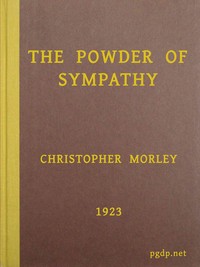
The Powder of Sympathy — Reading Companion
(0 User reviews)
1559
Project Gutenberg
2022
Not confirmed
American essays -- 20th century
Readers of public-domain and historical texts
Project Gutenberg digital edition
en
Edition facts
Words
76,875
Reading time
335 min
Text sections
48
For The Powder of Sympathy — Reading Companion, the stored edition analysis reports 76,875 words, 5 hr 35 min estimated reading time, and 48 detected text sections.
The text analysis averages about 20.4 words per sentence, while the detected sections provide another way to judge how the source is divided.
Project Gutenberg metadata also associates the work with “American essays -- 20th century,” connecting these edition facts with the source record’s subject description.
Source:
Project Gutenberg record #67188
Christopher Morley's 1923 collection of newspaper essays, framed by a fictional correspondence about a digestive-candy startup, blends literary musings, advertising satire, and urban observation with a playful, self-deprecating voice.
Editorial Edition Score
4.9/5
★★★★★
★★★★★
Calculated from edition completeness, EPUB availability, text structure and catalogue metadata. Not a user rating.
How this score is calculated
- Description quality20 pts
- Title & short description10 pts
- Source metadata20 pts
- Text length15 pts
- Chapters / structure15 pts
- EPUB file integrity20 pts
Total of 100 points, scaled to a 2.5-5.0 range. Editions with an empty description or a missing EPUB file are not scored.
Edition quality
Read the Text
fact that Treble X was obtainable only by the glass. Vital stuff, evidently. Our education was going to come partly in casks, perhaps? In the Kitchen Tariff we read, gloatingly, magnificent syllables. _Grilled Sausages and Bacon_, commons, 1/2. _Devilled Kidneys_, commons, 1/. (A “commons,” we judged, was a large portion; if you wanted a lesser serving, you ordered a “small commons.”) _Chop with Chips_, 11d. _Grilled Bones_, 10d. _Kedgeree_, plain or curried, commons, 9d. (Oh noble kedgeree, so nourishing and inexpensive, when shall we taste your like again?) Herrings, Bloaters, Kippers, each 3d. (To think that, then, we thought the Junior Bursar’s tariff was a bit steep.) Jelly, Compôte of Fruit, Trifle, Pears and Cream. Creams ... commons, 6d. “Gentlemen’s own birds cooked and served ... one bird, 1/. Two birds, 1/6.”
We went on, with enlarging appreciation, to the Store Room and Cellar Tariffs: Syphons, Seltzer or Soda-water, 4½d. Ginger-beer, per bottle, 2d. Cakes: Genoa, Cambridge, Madeira, Milan, Sandringham, School, each 1/. Foolscap, per quire, 10d. Quill Pens, per bundle, 1/6. Cheroots, Cigars, Tobacco, Cigarettes--and then we found what seemed to be the crown and cream of our education, LIST OF WINES.
Port, 4/ per bottle. Pale Sherry, 3/. Marsala, 2/. Madeira, 4/. Clarets: Bordeaux, 1/6. St. Julien, 2/. Dessert, 4/. Hock or Rhenish Wine: Marcobrunner, 4/. Niersteiner, 3/. Moselle, 2/6. Burgundy, 2/ and 4/. Pale Brandy, 5/. Scotch Whisky, 4/. Irish Whisky, 4/. Gin, 3/. Rum, 4/.
It is really too bad to have to compress into a few paragraphs such a wealth of dreams and memories. We sat there, with our little pamphlet before us, and looked out at that great panorama of spires and towers. We have always believed in falling in with our environment. The first thing we did that afternoon was to go out and buy a corkscrew. We have it still--our symbol of an Oxford education.
The man who did most (I am secretly convinced) to deprive American literature of some really fine stuff was Mr. John Wanamaker. It was in his store, some years ago, that I bought a kind of cot-bed or couch, which I put in one corner of my workroom and on which it is my miserable habit to recline when I might be getting at those magnificent writings I have planned. Every evening I pile up the cushions and nestle there with _The Gentle Grafter_ or some detective story (my favourite relaxation), saying to myself: “Just ten minutes of loafing”....
But perhaps Messrs. Strawbridge and Clothier (also of Philadelphia) are equally at fault. When I wake up, on my Wanamaker divan, it is usually about 2 A. M. Not too late, even then, for a determined spirit to make incision on its tasks. But I find myself moving towards a very fine white-enamelled icebox which I bought from Strawbridge and Clothier in 1918. With that happy faculty of self-persuasion I convince myself it is only to see whether the pan needs emptying or the doors latching. But by the time I have scalped a blackberry pie and eroded a platter of cold macaroni au gratin, of course work of any sort is out of the question.
So do the Philistines of this world league themselves cruelly against the artist, plotting temptation for his carnal deboshed instincts, joying to see him succumb. Once the habit of yielding is established, Wanamaker, Strawbridge and Clothier (dark trio of Norns) have it their own way. Just as surely as robins will be found on a new-mown lawn, as certainly as bonfire smoke veers all round the brush pile to find out the eyes of the suburban leaf burner, so inevitably do the Divan and the Icebox exert their cruel dominion over us when we ought to be pursuing our lovely and impossible dreams. Wanamaker and Strawbridge and Clothier have blueprints of the lines of fissure in our frail velleity. As William Blake might have said:
Let Flesh once get a lead on Spirit, It’s hard for Soul to reinherit: When supper’s laid upon a plate Mind might as well abdicate.
But one of the things I think about, just before I drop off to sleep on that couch, is My Anthology. Like every one else, I have always had an ambition to compile an anthology of my own; several, in fact. One of them I call in my own mind _The Book of Uncommon Prayer_, and imagine it as a kind of secular breviary, including many of those beautiful passages in literature expressing the spirit of supplication. This book, however, it will take years to collect; it will be entirely non-sectarian and so truly religious that many people will be annoyed. People do not care much for books of real beauty. That anthology edited by Robert Bridges, for instance--_The Spirit of Man_--how many readers have taken the trouble to hunt it out?
Christopher Morley's The Powder of Sympathy opens with a dedication that sets its tone: a book is a "frail and human emanation," and these pieces were written "out of the pressure and hilarity and contention of the mind." The title itself, borrowed from Sir Thomas Browne's term for a sympathetic powder, hints at a collection that aims to connect disparate thoughts. The first excerpt reveals a fictional correspondence between Nicholas Ribstone, president of the Ginger Cubes Corporation, and a nurse, Candida Cumnor, about a delirious advertising manager. This framing device—a business venture for "Digestive Dice"—introduces Morley's characteristic blend of whimsy and satire.
A Newspaperman's Scrapbook
The book's structure is openly episodic. Morley acknowledges its "ephemeral origin" in the dedication, noting the pieces were "almost all written for a newspaper." The excerpts show a range of subjects: a letter about a failed Tolstoy mailing list, a proposal for subway ads shaped like dice, and a nurse's report on a patient's delusions. This variety suggests the collection is less a unified narrative than a mosaic of observations, linked by Morley's consistent voice—wry, self-aware, and fond of digression. Readers should expect abrupt shifts in topic and tone, as the author moves from literary allusion to commercial parody without warning.
The Ginger Cubes Correspondence
A substantial portion of the excerpts revolves around the Ginger Cubes Corporation, a fictional company selling digestive candies. The letters between Ribstone and Cumnor reveal a satirical take on advertising: slogans like "DIGESTIVE DICE MEAN LUCK FOR THE LIVER" and a proposed subway map of the digestive system. Morley uses this subplot to mock marketing jargon and the credulity of consumers. The nurse's letter, noting that the patient "had been trying to sell by mail order a complete set of Tolstoy's works" to the Ku Klux Klan, adds a layer of absurdist humor. This thread, though incomplete in the excerpts, appears to be a recurring motif that ties the essays together.
Voice and Self-Deprecation
Morley's prose is marked by a conversational, slightly self-mocking tone. In the dedication, he worries about being "too apologetic in a preface," then immediately undercuts that concern. The letters show characters who are earnest yet ridiculous—Ribstone frets about gender appeal in advertising, while the nurse describes a patient who mistakes a fever chart for a sales graph. This layering of voices—author, businessman, medical professional—creates a polyphonic effect. The excerpts suggest Morley is less interested in plot than in the comedy of human folly, especially in the realms of commerce and literature.
Reading Between the Letters
Because the excerpts are incomplete, the overall arc of the collection remains unclear. The Ginger Cubes correspondence may be a framing device or one of many sketches. Readers should note the absence of a traditional narrative: the book is cataloged as essays, not fiction, despite the fictional letters. Morley's dedication hints at a desire to "encourage the youngest generation of journalists to be themselves," suggesting the pieces are also a meta-commentary on writing. The excerpts contain no resolution to the Ginger Cubes story, so readers should approach the book as a series of vignettes rather than a novel.
Morley's The Powder of Sympathy rewards readers who enjoy wit, literary references, and a loose, essayistic structure. The Ginger Cubes subplot offers a satirical lens on 1920s advertising, while the dedication and letters reveal a writer comfortable with self-mockery. Because the excerpts are fragmentary, the full collection likely contains many more such episodes. Approach it as a cabinet of curiosities, not a linear story, and let Morley's voice guide you through the digressions.
There’s a gentle ache in rereading Morley’s candy-company letters, that blend of earnest hustle and quiet bookish longing. It reminds me of sitting with Essays in Literature and History — Background and Themes, where the same tender eye turns toward what we carry forward. Both feel like old friends—worn, a little dusty, but glad to see you again.
There are no reviews for this eBook.
There are no comments for this eBook.
Reader reflection
What did you think of this book?
Answer a few questions and save a private reflection on this device.
Your progress
0
/
10
2
Was reading this book enjoyable?
3
Would you pass this book on to a friend?
4
What was the reading difficulty like?
5
Could you follow the author’s main argument?
6
Did it raise ideas you would like to talk about?
7
Was the book moving at the right speed?
8
Is this a title worth rereading?
9
Which lesson or insight stayed with you?
10