1

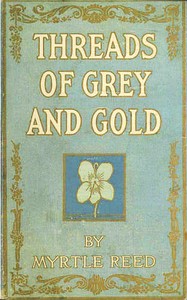
Threads of Grey and Gold — A Closer Reading
(0 User reviews)
1287
Project Gutenberg
2010
Not confirmed
Poetry; Essays
Readers of public-domain and historical texts
Project Gutenberg digital edition
en
Edition facts
Words
63,863
Reading time
278 min
Text sections
8
The catalog record for Threads of Grey and Gold — A Closer Reading provides practical reading context through 63,863 words, 4 hr 38 min estimated reading time, and 8 detected text sections.
The text analysis averages about 22.7 words per sentence, while the detected sections provide another way to judge how the source is divided.
Project Gutenberg metadata also associates the work with “Poetry,” connecting these edition facts with the source record’s subject description.
Source:
Project Gutenberg record #31272
Myrtle Reed's collection of essays and poems blends wit and sentiment on women's roles, creativity, and domestic life, with a distinctive voice that challenges and chafes against early 20th-century norms.
Editorial Edition Score
4.7/5
★★★★★
★★★★★
Calculated from edition completeness, EPUB availability, text structure and catalogue metadata. Not a user rating.
How this score is calculated
- Description quality20 pts
- Title & short description10 pts
- Source metadata20 pts
- Text length15 pts
- Chapters / structure15 pts
- EPUB file integrity20 pts
Total of 100 points, scaled to a 2.5-5.0 range. Editions with an empty description or a missing EPUB file are not scored.
Edition quality
Public-domain source text
Read the source text
The source text is kept in the dedicated reader, separate from this catalogue record and its commentary.
Threads of Grey and Gold opens with a dedicatory poem that frames Reed's work as a woven fabric of "sunbeams of gold" and "silvery fold," setting a tone of crafted sentiment. The editorial note reveals these pieces first appeared in periodicals, collected for preservation. The opening essay immediately confronts the reader with a sharp, ironic voice on women's place: "We have no Shakespeare, Michelangelo, or Beethoven," Reed declares, before pivoting to a mock-serious proposal that men darn stockings and iron lace. This blend of humor and critique establishes a pattern of indirection—Reed often masks serious argument with playful exaggeration.
A Voice That Shifts Between Irony and Earnestness
Reed's rhetorical strategy is evident from the first pages. She adopts a persona that is both aggrieved and amused, as when she notes that men "chivalrously shield us from the exhausting effort of voting, but allow us to stand in the street-cars." The tone is conversational, addressing "dear friends" and "dear reader," yet the observations are pointed. She undercuts her own arguments with self-deprecation: "Our short-sightedness, our weakness for kind words, our graceful acceptance of the entire responsibility for the home, have chained us to the earth." This layered voice—part lament, part jest—requires the reader to gauge when Reed is being literal and when she is employing satire. The excerpts do not reveal whether this tone persists throughout the entire collection, but it dominates the opening essay.
Domestic Labor as a Lens for Inequality
Reed repeatedly returns to the physical and mental labor of women in the home. She describes primitive woman dressing game, making clothing, and crafting tools, while man "repaired to a secluded nook in the jungle" to discuss politics. The parallel to twentieth-century marriage is explicit: the wife still mends socks and presses ties, while the husband "roams the highways of the world." Reed's examples are concrete—"blacked his boots," "run a line of machine stitching around the middle of the hem"—and she frames domestic work as unacknowledged economic contribution. The essay argues that a wife who does housework for "board and clothes" is no different from a paid servant, except she receives "kind words" instead of wages. This materialist critique is woven into a style that remains light and anecdotal.
Motherhood as a Career, Not a Default
In a striking passage, Reed asserts that "Motherhood is a career for which especial talents are required" and that it is unreasonable to assume all women can be good mothers, just as not all can sing in grand opera. This reframes a traditional role as a specialized vocation, not an automatic duty. She adds a wry observation: the difference between "our angelic offspring, and the little imps next door" proves the point. The essay does not develop this idea further in the excerpts, but it suggests Reed's willingness to question even the most sacred assumptions about women's nature. The tone remains consistent—playful yet pointed—and the reader is left to wonder how this argument might be expanded in later pieces.
The Structure of a Periodical Collection
The editorial note confirms that these essays were first published in various periodicals and later gathered into book form. This origin shapes the reading experience: each piece is self-contained, likely with its own argument or anecdote, and the collection as a whole may lack a single narrative arc. The opening essay establishes a strong authorial voice and a set of recurring concerns—women's work, intellectual equality, the gap between ideal and reality—but the excerpts do not indicate how later essays might vary in topic or tone. Readers should approach each chapter as an independent unit, while watching for threads of grey and gold: the sober critique and the golden humor that Reed weaves together.
Threads of Grey and Gold rewards a reader who attends to Reed's shifts in register—when she is being ironic, when earnest, and when both at once. The opening essay sets expectations for a voice that is at once aggrieved and amused, domestic and philosophical. As you move through the collection, note how Reed varies her subjects and whether the tone remains consistent or evolves. The periodical origins mean each piece stands alone, but the cumulative effect may reveal a more complex portrait of the author's thinking than any single essay suggests.
There’s a moment in Threads of Grey and Gold where Reed admits she’d rather make a pot of soup than a clever remark—and I felt seen. Her quiet rebellion lingers. I keep A Librarian's Open Shelf: Essays on Various Subjects — Story, Setting & Ideas beside it now, two steady voices for days when you need permission to simply set down your own bright edges for a while.
There are no reviews for this eBook.
There are no comments for this eBook.
Reader reflection
How will you remember this book?
Save your reaction, strongest insight, and memorable passage.
Your progress
0
/
10
2
How much did you enjoy the reading experience?
3
Would you recommend this book to another reader?
4
How easy was the book to follow?
5
Do you expect to return to this book?
6
Could you follow the author’s main argument?
7
How personally connected did you feel to the book?
8
How useful did the reading feel?
9
What did this book teach you most?
10