1

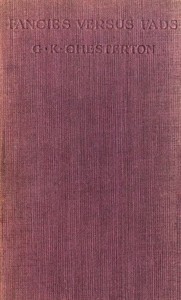
Fancies Versus Fads — Edition Insights
(0 User reviews)
1950
Project Gutenberg
2019
Not confirmed
English essays -- 20th century
Readers of public-domain and historical texts
Project Gutenberg digital edition
en
Edition facts
Words
72,975
Reading time
318 min
Text sections
7
For Fancies Versus Fads — Edition Insights, the stored edition analysis reports 72,975 words, 5 hr 18 min estimated reading time, and 7 detected text sections.
The text analysis averages about 22.6 words per sentence, while the detected sections provide another way to judge how the source is divided.
Project Gutenberg metadata also associates the work with “English essays -- 20th century,” connecting these edition facts with the source record’s subject description.
Source:
Project Gutenberg record #60164
Chesterton's 1923 essay collection uses paradox and wit to critique modern fads—from free verse to psychoanalysis—arguing that only a traditional, normal standpoint can truly appreciate eccentricity as fantasy.
Editorial Edition Score
4.7/5
★★★★★
★★★★★
Calculated from edition completeness, EPUB availability, text structure and catalogue metadata. Not a user rating.
How this score is calculated
- Description quality20 pts
- Title & short description10 pts
- Source metadata20 pts
- Text length15 pts
- Chapters / structure15 pts
- EPUB file integrity20 pts
Total of 100 points, scaled to a 2.5-5.0 range. Editions with an empty description or a missing EPUB file are not scored.
Edition quality
Public-domain source text
Read the source text
The source text is kept in the dedicated reader, separate from this catalogue record and its commentary.
Chesterton opens Fancies Versus Fads by describing his essays as “slight things” strung on a “slight enough thread,” yet the thread itself is a provocative claim: only a traditional spirit can truly wander. Modern theorists, he argues, are imprisoned in their own generalizations—the Marxist cannot leave economics, the Freudian must never forget sex. This paradox—that the orthodox are the free ones—sets the tone for a collection that treats heresies as fantasies and eccentrics as unwitting elves.
The essays range from lady barristers to cave-men, from psycho-analysis to free verse, but Chesterton insists they share a unity: that frivolity is “the last lingering form of freedom.” The reader is invited to see the nonsense of the world through a mirror of moderate sense, where even insanities become clear images for the imagination.
The Paradox of the Normal Standpoint
Chesterton’s introduction establishes his central rhetorical move: he positions himself as the ordinary, humdrum person who can enjoy eccentricity as “a sort of elfland,” while the eccentrics are “too serious even to know that they are elves.” This inversion—where the wild theorist is the limited one—recurs throughout the collection. When a man disapproves of fairy-tales, Chesterton notes, it is the ordinary person who perceives that the man himself is a fairy. The technique is not mere cleverness; it is a structural principle. Chesterton repeatedly takes a fad (free verse, divorce reform, cave-man theories) and turns it inside out, showing that its proponents are trapped by their own logic. The normal standpoint, he argues, is the only one from which all the nonsense of the world can appear as “wild interest of wonderland.”
Institutional Thinking vs. Individual Experience
In the essay on marriage and divorce, Chesterton criticizes sociologists who treat marriage only as an individual experience, ignoring it as an institution. He argues that this indifference stems from a deeper hostility to the “distributive society”—a society where property, especially land, is widely held. Marriage, he claims, has always been the pillar of such a society: “the farm goes with the family and the family with the farm.” By contrast, the Servile State is embarrassed by marriage, because slavery historically broke up families. Chesterton’s language sharpens into aphorism: “Free love is the direct enemy of freedom. It is the most obvious of all the bribes that can be offered by slavery.” He ties this to a historical sweep from pagan slavery to Christian martyrdom, warning that the new Servile State would settle into “sleepy resignation” if not for the ideals of liberty and chivalry.
The Misuse of Tools and Laws
In “Street Cries and Stretching the Law,” Chesterton attacks the habit of using things for purposes other than their own—a corkscrew to open a sardine-tin, a door-scraper as a paperweight. He calls this “practical politics,” where a law that failed to do its intended job is excused because it might do something else. This is not even lazy, he insists; it is a failure of imagination. The essay exemplifies Chesterton’s method of taking a mundane image and expanding it into a critique of modern thought. The tone is conversational but pointed, moving from the absurdity of mismatched tools to the larger principle that institutions and objects have intrinsic purposes. The reader is left to consider how many modern fads are simply misapplications—using a law meant for one end to achieve its opposite, or treating a custom as a substitute for its contrary.
Chesterton’s prose moves between playful paradox and urgent warning, often within the same paragraph. Readers will find that the essays reward attention to his shifts in pace—from the leisurely, anecdotal opening of a piece to the sudden, aphoristic punch of its conclusion. The collection is best read not as a systematic argument but as a series of intellectual provocations, each inviting the reader to see the familiar fad from an unexpected angle. Chesterton’s voice, at once conversational and epigrammatic, remains the unifying thread.
That rainy afternoon, Chesterton’s paradoxes kept me company, his laughing defense of the ordinary softening the gray gloom. I closed Fancies Versus Fads feeling oddly steady, less alarmed by modern noise. Then, almost by accident, my hand found Mushrooms on the Moor — Reading Notes, and the quiet there felt like the same old ground, just walked slower.
There are no reviews for this eBook.
There are no comments for this eBook.
Reader reflection
What did you think of this book?
Answer a few questions and save a private reflection on this device.
Your progress
0
/
10
2
How did the book work for you overall?
3
Would you pass this book on to a friend?
4
How demanding did the text feel?
5
Did the story or argument move comfortably?
6
What was the strongest part of the book?
7
What was its emotional impact?
8
Could you apply anything you learned?
9
What is the main idea you are taking away?
10