1

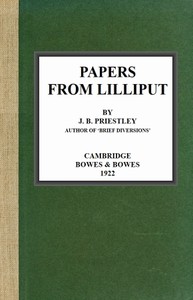
Papers from Lilliput — Text and Context
(0 User reviews)
682
Project Gutenberg
2015
Not confirmed
English essays -- 20th century
Readers of public-domain and historical texts
Project Gutenberg digital edition
en
Edition facts
Words
50,573
Reading time
220 min
Text sections
5
This digital edition of Papers from Lilliput — Text and Context is described by source-level measurements including 50,573 words, 3 hr 40 min estimated reading time, and 5 detected text sections.
The text analysis averages about 27.0 words per sentence, while the detected sections provide another way to judge how the source is divided.
Project Gutenberg metadata also associates the work with “English essays -- 20th century,” connecting these edition facts with the source record’s subject description.
Source:
Project Gutenberg record #49950
J. B. Priestley's 1922 essay collection blends literary portraiture, whimsical travel notes, and reflections on human foibles, drawing on pseudonymous columns and periodical pieces with a playful, Swiftian tone.
Editorial Edition Score
4.7/5
★★★★★
★★★★★
Calculated from edition completeness, EPUB availability, text structure and catalogue metadata. Not a user rating.
How this score is calculated
- Description quality20 pts
- Title & short description10 pts
- Source metadata20 pts
- Text length15 pts
- Chapters / structure15 pts
- EPUB file integrity20 pts
Total of 100 points, scaled to a 2.5-5.0 range. Editions with an empty description or a missing EPUB file are not scored.
Edition quality
Public-domain source text
Read the source text
The source text is kept in the dedicated reader, separate from this catalogue record and its commentary.
Priestley opens his 1922 collection by rescuing an obscure eighteenth-century actor, Bridge Frodsham, from the pages of The Eccentric Mirror, a compendium of 'extraordinary Qualifications, Talents, and Propensities.' This gesture sets the tone for a volume that repeatedly turns to forgotten or eccentric figures—a provincial player, a cheap-jack, a mad shepherd—as vehicles for broader commentary. The essays, drawn from periodicals including The London Mercury and the Yorkshire Observer (where Priestley wrote as 'Peter of Pomfret'), are unified by a conversational voice that blends erudition with a fondness for the odd and overlooked.
A Gallery of Eccentrics
The catalog subject 'English essays—20th century' gives little hint of Priestley's method. Rather than abstract themes, he builds arguments around specific, often obscure characters. In 'On a Certain Provincial Player,' he reconstructs the career of Bridge Frodsham, the 'York Garrick,' from a single source. The essay 'The Eternal Cheap-Jack' turns a street vendor into a symbol of 'primal innocence,' his patter rendered in dialect: 'One of a click is 'e?' he would roar. Priestley's portraits are not mere antiquarianism; they serve as springboards for reflections on praise, poetry, and the 'fine old notion' of getting something for nothing.
The Play of Literary Allusion
Priestley's essays are densely woven with literary references, but he uses them as playful building blocks rather than scholarly ornaments. 'Holiday Notes from the Coast of Bohemia' is a sustained conceit: a letter from Autolycus (Shakespeare's The Winter's Tale) describing a resort where Prince Florizel and Perdita reign, and guests include Benedick, Beatrice, Touchstone, and Gil Blas. The essay 'On a Certain Contemporary Essayist' presumably turns the mirror on a fellow writer. This habit of populating his pages with borrowed characters gives the collection a distinctive texture—part criticism, part fiction, part gossip.
Voice and Structure Across Sources
The essays originated in different venues—weekly columns, literary monthlies—and their variety is evident. Some, like 'On Getting Off to Sleep' or 'On Travel by Train,' are personal reflections in the familiar essay tradition. Others, like 'The Dream' or 'The Peep,' hint at narrative experiments. Priestley's pseudonymous 'Peter of Pomfret' pieces likely contributed a more colloquial, Yorkshire-inflected tone. The collection's structure—five sections, though the excerpts show only the opening and closing—suggests an arc from historical portraiture through social observation to lighter domestic topics, but the excerpts are too partial to confirm a deliberate progression.
Readers approaching Papers from Lilliput should expect a miscellany, not a unified argument. The Swiftian title signals irony, but the essays are more genial than satiric. Priestley's habit of embedding literary allusions and resurrecting forgotten figures rewards attention to his sources—The Eccentric Mirror, Shakespeare's romances, the picaresque tradition. The collection is best read as a cabinet of curiosities, each piece a self-contained performance by a writer finding his voice.
Priestley’s little islands of ink—those Swiftian glances at our own absurdities—make me oddly nostalgic for a time when essays felt like letters to a friend. That same quiet, tax-and-spend bewilderment surfaces in War Taxation: Some Comments and Letters — Edition Insights, though there the ink is drier, the jokes fewer. I suppose we never really escape the ledger, even in Lilliput. War Taxation: Some Comments and Letters — Edition Insights sits beside it on my shelf now, a sterner companion.
There are no reviews for this eBook.
There are no comments for this eBook.
Reader reflection
Your personal reading reflection
Build a private reading journal entry for this title.
Your progress
0
/
10
2
How much did you enjoy the reading experience?
3
Would you pass this book on to a friend?
4
What was the reading difficulty like?
5
How did the pace of the book feel?
6
Which aspect of the book did you value most?
7
Did the book offer a fresh perspective?
8
How clear did the writing feel?
9
In one sentence, what did you learn?
10