1

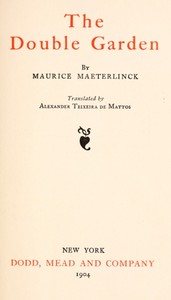
The Double Garden — Background and Themes
(0 User reviews)
132
Project Gutenberg
2015
Not confirmed
Essays
Readers of public-domain and historical texts
Project Gutenberg digital edition
en
Edition facts
Words
47,881
Reading time
209 min
Text sections
5
For The Double Garden — Background and Themes, the stored edition analysis reports 47,881 words, 3 hr 29 min estimated reading time, and 5 detected text sections.
The text analysis averages about 29.5 words per sentence, while the detected sections provide another way to judge how the source is divided.
Project Gutenberg metadata also associates the work with “Essays,” connecting these edition facts with the source record’s subject description.
Source:
Project Gutenberg record #48504
Sixteen essays by Maurice Maeterlinck on dogs, chance, swords, death, suffrage, drama, prophecy, automobiles, spring, bees, flowers, sincerity, and portraits. The prose shifts from intimate elegy to philosophical meditation to lyrical nature observation, with a distinctive voice that blends precise description with speculative reflection.
Editorial Edition Score
4.7/5
★★★★★
★★★★★
Calculated from edition completeness, EPUB availability, text structure and catalogue metadata. Not a user rating.
How this score is calculated
- Description quality20 pts
- Title & short description10 pts
- Source metadata20 pts
- Text length15 pts
- Chapters / structure15 pts
- EPUB file integrity20 pts
Total of 100 points, scaled to a 2.5-5.0 range. Editions with an empty description or a missing EPUB file are not scored.
Edition quality
Public-domain source text
Read the source text
The source text is kept in the dedicated reader, separate from this catalogue record and its commentary.
The opening essay, "Our Friend, the Dog," begins with a personal loss: a six-month-old bulldog named Pelléas has died. Maeterlinck describes the dog's forehead as "like that of Socrates or Verlaine" and calls him "a beautiful, natural monster that has complied strictly with the laws of its species." This intimate, almost tender observation sets a tone that recurs throughout the collection—a willingness to find profundity in the ordinary and to treat animals, objects, and ideas with equal seriousness.
The essays range widely: from the psychology of gambling in "The Temple of Chance" to the exhilaration of early motoring in "In an Automobile," where the narrator notes that "the entire road is one long succession of arrivals." Maeterlinck's voice is consistently meditative, but the pace varies—sometimes lingering on a single image, sometimes moving briskly through a chain of reflections.
From Elegy to Philosophy
The first essay establishes a pattern of moving from a concrete, personal event to broader philosophical speculation. The death of Pelléas prompts reflections on canine devotion and the nature of love. Maeterlinck describes the dog's "smile of attentive obligingness" and his "incorruptible innocence," but quickly shifts to consider what such loyalty reveals about human relationships. This structure—anchoring abstract thought in a specific, often humble subject—recurs in later essays. In "The Wrath of the Bee," for instance, he examines the insect's aggression as a window into instinct and morality. The transitions are not always smooth; sometimes the shift feels abrupt, as though the author has suddenly remembered a larger argument. Yet this very unevenness gives the collection a sense of genuine inquiry, of thoughts being worked out on the page rather than polished into neat conclusions.
The Pace of Observation
Maeterlinck's descriptive passages often move slowly, accumulating details with patient attention. In "News of Spring," he watches spring "hesitate once more to face the great frost-traps" beyond the mountains, personifying the season as a child "running round the garden of its holidays." The prose lingers on the Mediterranean landscape—"the olive-tree that quivers with a silver smile," "the strange brown cowls of the arisarum." But elsewhere, the pace quickens. In "In an Automobile," the narrator celebrates speed: "the joys of the journey's end are multiplied, for all things adopt the admirable form of the end." The contrast between these two modes—the slow, almost botanical gaze and the exhilarated, forward-thrusting motion—creates a rhythm that keeps the reader alert. The collection does not maintain a single tempo; it shifts gear as the subject demands.
Voice and the First Person
Throughout the sixteen essays, Maeterlinck uses the first person not to confess or confide, but to anchor his reflections in a particular sensibility. He writes as an observer who is also a participant: he has owned a dog, visited a casino, ridden in an automobile, walked through spring fields. Yet the "I" rarely becomes intrusive; it serves as a lens rather than a subject. In "The Temple of Chance," he describes the gambler's psychology without claiming personal experience of addiction. In "In Praise of the Sword!" he adopts a more rhetorical, almost public voice. This flexibility—shifting between intimate and detached, personal and universal—gives the collection a varied texture. The translations by Alexander Teixeira de Mattos and Alfred Sutro preserve a formal, slightly archaic elegance that suits Maeterlinck's measured tone, though occasionally the syntax becomes convoluted, as in the long, clause-heavy sentences of "The Foretelling of the Future."
Readers approaching The Double Garden should expect neither a unified argument nor a straightforward travelogue. The essays reward those who read them slowly, allowing each meditation to settle before moving to the next. Maeterlinck's method is associative rather than systematic; he follows a thought where it leads, even if it doubles back or diverges. The collection's title hints at this dual quality—a garden that is both literal and metaphorical, personal and universal. Pay attention to the moments when the prose slows down or speeds up; they often signal a shift in the writer's attention, and in what he wants the reader to see.
That rainy afternoon, I sank into Maeterlinck’s essays—his thoughts on chance and dogs lingered oddly, like wet leaves on a path. His quiet acceptance of uncertainty felt so intimate that, when the book ended, I reached for something gentler without thinking. I found The Comforts of Home — A Reader’s Guide beside it, and its softness mirrored that same unhurried warmth, as if one book had simply grown into the other.
There are no reviews for this eBook.
There are no comments for this eBook.
Reader reflection
What did you think of this book?
Answer a few questions and save a private reflection on this device.
Your progress
0
/
10
2
Did this book hold your interest?
3
Would you encourage someone else to read it?
4
How demanding did the text feel?
5
Do you expect to return to this book?
6
How strongly did the book affect you emotionally?
7
How useful were the ideas in this book?
8
How did the reading compare with what you expected?
9
What is the main idea you are taking away?
10