1

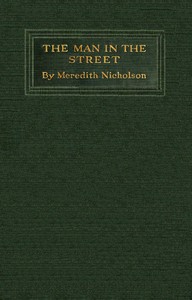
The man in the street: Papers on American topics — A Reader’s Guide
(0 User reviews)
823
Project Gutenberg
2023
Not confirmed
American essays -- 20th century
Readers of public-domain and historical texts
Project Gutenberg digital edition
en
Edition facts
Words
54,223
Reading time
236 min
Text sections
16
The catalog record for The man in the street: Papers on American topics — A Reader’s Guide provides practical reading context through 54,223 words, 3 hr 56 min estimated reading time, and 16 detected text sections.
The text analysis averages about 24.9 words per sentence, while the detected sections provide another way to judge how the source is divided.
Project Gutenberg metadata also associates the work with “American essays -- 20th century,” connecting these edition facts with the source record’s subject description.
Source:
Project Gutenberg record #69677
Meredith Nicholson's 1921 essay collection uses a fictional 'man in the street' persona to examine American life through recurring motifs of urban movement, church architecture, and conversational framing, with each piece anchored in specific Midwestern settings.
Editorial Edition Score
4.8/5
★★★★★
★★★★★
Calculated from edition completeness, EPUB availability, text structure and catalogue metadata. Not a user rating.
How this score is calculated
- Description quality20 pts
- Title & short description10 pts
- Source metadata20 pts
- Text length15 pts
- Chapters / structure15 pts
- EPUB file integrity20 pts
Total of 100 points, scaled to a 2.5-5.0 range. Editions with an empty description or a missing EPUB file are not scored.
Edition quality
Public-domain source text
Read the source text
The source text is kept in the dedicated reader, separate from this catalogue record and its commentary.
Meredith Nicholson opens his foreword by questioning his own authority to speak for the average American, a self-deprecating move that sets the tone for the sixteen essays collected here. The volume's structure is deliberately loose: Nicholson notes the 'apparent unrelated character' of the subjects but insists on a 'certain cohesion,' arguing that in his Midwestern experience, 'literature, politics, religion, and the changing social scene are all of a piece.' This claim is tested across essays that move from a fictional town's church dispute to reflections on James Whitcomb Riley, the 'Cheerful Breakfast Table,' and political commentary preserved without later revision. The excerpts reveal a writer who builds arguments through anecdote and reported conversation, often positioning himself as a curious observer rather than a polemicist.
The Persona of the Man in the Street
Nicholson's titular figure is less a character than a rhetorical stance. In the foreword, he admits his right to speak for the average American is 'open to serious question,' and he playfully imagines that some would rate him higher than average, others lower. This self-awareness recurs throughout the excerpts: the narrator in 'Let Main Street Alone!' presents himself as a traveling investigator, skeptical of a young solicitor's church invitation, yet he is drawn into the story of the 'Church For Honest Sinners.' The persona is not a fixed identity but a flexible device that allows Nicholson to shift between insider and outsider, critic and sympathizer. He claims he can find answers to any question by 'planting myself on the post-office steps,' a boast that underscores his faith in local knowledge. This framing gives the essays a conversational, almost improvisational quality, as if the reader is overhearing a series of thoughtful monologues.
Recurring Images: Churches, Streets, and Urban Movement
Two images dominate the excerpts: the church and the street. In 'Let Main Street Alone!,' the narrator contrasts St. John's, a new stone church, with a white wooden structure across the street, boarded up and labeled 'The Church For Honest Sinners.' The physical proximity of the two buildings—one saintly, one shuttered—becomes a metaphor for the town's social divisions. The street itself is a stage: the narrator observes men lounging in the hotel lobby, a stout gentleman in checks pointing with a card, and church-bells clanging 'importunately' as a backdrop. Nicholson frequently anchors his scenes in specific urban details—the 'fifteenth floor of an office-building,' the 'post-office steps,' the 'slum which the town had acquired with its prosperity.' These settings are not merely decorative; they ground his abstract arguments in tangible, often ironic, contrasts between aspiration and reality.
Conversation as Argument: The Dialogic Structure
Nicholson often advances his ideas through reported dialogue rather than direct thesis. In the excerpt, the narrator's exchange with the young solicitor unfolds over several pages, with the solicitor revealing the story of the sinners' church through hesitant, almost conspiratorial replies. The narrator's own comments—'I felt guiltily that the topic might have been chosen providentially'—add a layer of self-mockery. This method allows Nicholson to explore multiple perspectives without committing to a single position. The solicitor's nervous handling of a pack of cards, the narrator's scrutiny of his 'wholesome-looking' face, and the amused glances from the cigar-stand all contribute to a scene that feels more like a short story than an essay. The political pieces, by contrast, are described as 'sufficiently explained by their dates,' suggesting a more direct approach, but the conversational mode remains the collection's most distinctive structural feature.
Movement Between Scales: From Local Anecdote to National Commentary
The essays shift fluidly between the intimate and the general. A single conversation in a hotel lobby can open onto questions of church nomenclature, labor conditions, and the nature of sin. Nicholson's foreword establishes this method: he moves from a lawyer friend's help identifying a Beethoven symphony to a claim about the 'happy conditions of life' in his home province. The excerpts show him zooming in on a boarded-up church, then zooming out to reflect on why 'the idea of sin isn't exactly popular.' This oscillation is not random; it reflects Nicholson's belief that the local contains the national. The political articles, he notes, are reprinted 'without alteration' for future students, implying that even dated commentary can illuminate broader patterns. The reader is invited to follow these movements, trusting that the 'certain cohesion' Nicholson promises will emerge from the accumulation of specific, grounded observations.
Readers approaching The Man in the Street should attend to the way Nicholson builds his arguments from the ground up—through overheard remarks, architectural details, and the rhythms of small-city life. The essays reward attention to their conversational texture and the persona of the narrator, who is both a participant and a skeptic. Because the collection preserves political pieces from different years, it offers a layered view of American attitudes in the 1910s and early 1920s, though Nicholson's own stance remains deliberately elusive. Treat each essay as a self-contained scene, and the volume's cohesion will emerge not from a single thesis but from the consistent voice that ties them together.
That rainy afternoon, Nicholson’s Man in the Street kept me indoors, watching conversations drift like church bells across Indianapolis. His quiet faith in ordinary talk made me wonder how earlier Americans reasoned aloud. Later, rummaging for a bookmark, I found a volume of Jefferson’s letters — Memoir, Correspondence, and Miscellanies, From the Papers of Thomas Jefferson, Volume 3 — Themes and Context — and sat down, almost without deciding to.
There are no reviews for this eBook.
There are no comments for this eBook.
Reader reflection
How will you remember this book?
Save your reaction, strongest insight, and memorable passage.
Your progress
0
/
10
2
Did this book hold your interest?
3
Would you recommend this book to another reader?
4
Did the language feel accessible?
5
Could you follow the author’s main argument?
6
Did this book create an emotional response?
7
Was the book what you thought it would be?
8
Did any part of the book feel personally relevant?
9
What is the main idea you are taking away?
10