1

Under dispute — Story, Setting & Ideas
(0 User reviews)
918
Project Gutenberg
2023
Not confirmed
American essays -- 20th century
Readers of public-domain and historical texts
Project Gutenberg digital edition
en
Edition facts
Words
53,334
Reading time
232 min
Text sections
15
Under dispute — Story, Setting & Ideas can be approached with a clearer sense of reading commitment from its source measurements: 53,334 words, 3 hr 52 min estimated reading time, and 15 detected text sections.
The text analysis averages about 22.4 words per sentence, while the detected sections provide another way to judge how the source is divided.
Project Gutenberg metadata also associates the work with “American essays -- 20th century,” connecting these edition facts with the source record’s subject description.
Source:
Project Gutenberg record #71550
Agnes Repplier's 1924 essay collection examines Puritan resilience, American optimism, and the fragility of alliances, using historical anecdotes and sharp cultural commentary to question modern complacency.
Editorial Edition Score
4.8/5
★★★★★
★★★★★
Calculated from edition completeness, EPUB availability, text structure and catalogue metadata. Not a user rating.
How this score is calculated
- Description quality20 pts
- Title & short description10 pts
- Source metadata20 pts
- Text length15 pts
- Chapters / structure15 pts
- EPUB file integrity20 pts
Total of 100 points, scaled to a 2.5-5.0 range. Editions with an empty description or a missing EPUB file are not scored.
Edition quality
Public-domain source text
Read the source text
The source text is kept in the dedicated reader, separate from this catalogue record and its commentary.
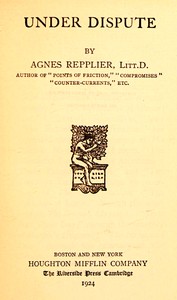
Agnes Repplier opens her 1924 collection Under Dispute with a pointed contrast: the Puritan as Scribe and Pharisee versus the Cavalier as publican and sinner. Rather than offer a straightforward defense, she dwells on a single stark detail—the Plymouth colonists went four years without a cow—to measure the gap between modern comfort and seventeenth-century endurance. Throughout these twelve essays, Repplier’s voice is that of a skeptical observer, fond of aphorism and historical parallel, who distrusts easy patriotism and sentimental retrospect.
The Puritan as a Mirror for Modern Complacency
In “The Masterful Puritan,” Repplier refuses to treat the Puritans as mere ancestors to be praised at commemorative dinners. She quotes William Brewster’s letter from the starving winter of 1620–21, where he calls the loss of half the colony a “small discontentment.” The irony is deliberate: Repplier uses the gap between Puritan language and modern sensibility to expose how little we understand their motives. She notes that for four years the colonists owned no cow, and that children who could not live without milk had only one alternative—to die. The detail is not sentimentalized; it is offered as a concrete measure of what “covenant” meant in practice. Repplier’s method is to let the historical record speak, then to draw a quiet, damning contrast with the present.
The Rationality of Fear in a Dangerous World
In “Allies,” Repplier turns to international relations, citing Philippe de Commines’s observation that “friendship between princes is not of long duration.” She extends the principle to republics, arguing that national alliances rest on shifting interests, not affection. The essay moves from a fifteenth-century invasion conducted with “urbane” politeness to the modern reality of 365 strikes in a single year and 85,000 violent deaths in a decade. Repplier does not offer solutions; she points to a “something lacking” in industrial equity and peace. The closing quotation from Brownell—“The fact that fear is rational is what makes fortitude divine”—encapsulates her unsentimental realism. She treats fear not as weakness but as a precondition for genuine courage.
A Voice of Measured Skepticism
Repplier’s prose is marked by balanced clauses and a preference for the concrete over the abstract. She writes of the American belief in peace as something felt “under no passionate urgency to organize it.” The rhythm is deliberate: a short, declarative sentence followed by a longer, qualifying one. She avoids the first person, yet her judgments are unmistakable. When she notes that “grace before meat is not enough to bless the food we eat,” she is not preaching but observing a cultural habit of complacency. The essays are conversational in tone but tightly argued, each paragraph building on a single historical or literary reference. Repplier trusts her reader to catch the irony without underlining it.
Readers approaching Under Dispute will find a collection that rewards attention to its epigraphs and allusions. Repplier’s essays were originally published in The Atlantic Monthly, The Yale Review, and similar periodicals, and they retain the texture of magazine writing: pointed, self-contained, and aimed at an educated audience. The book does not build a single argument but circles around themes of endurance, illusion, and the cost of conviction. To read it is to watch a sharp mind testing received ideas against historical evidence.
There’s something bracing about Repplier’s trust in ordinary stubbornness—the way she reads Puritan resolve without flinching. It makes me think of her quieter essays, where that same steadiness hums under the prose. Literary values, and other papers — Themes and Context holds that gentler register, almost like a whispered footnote to the louder arguments. I keep returning to both, slightly amazed they’re still near.
There are no reviews for this eBook.
There are no comments for this eBook.
Reader reflection
How did this book work for you?
Your answers remain private and are stored only in this browser.
Your progress
0
/
10
2
What was your overall reaction to the book?
3
Is this a title you would suggest to others?
4
How much effort did this book require?
5
Was the book easy to understand?
6
Would you read this book again?
7
Would you like to discuss this book with someone?
8
What was the strongest part of the book?
9
Which lesson or insight stayed with you?
10