1

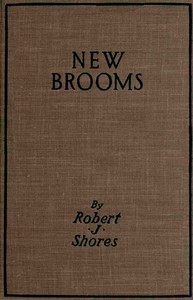
New Brooms — Key Ideas to Explore
(0 User reviews)
113
Project Gutenberg
2021
Not confirmed
American essays -- 20th century
Readers of public-domain and historical texts
Project Gutenberg digital edition
en
Edition facts
Words
50,920
Reading time
222 min
Text sections
32
Before opening New Brooms — Key Ideas to Explore, the edition data offers a quick orientation: 50,920 words, 3 hr 42 min estimated reading time, and 32 detected text sections.
The text analysis averages about 24.3 words per sentence, while the detected sections provide another way to judge how the source is divided.
Project Gutenberg metadata also associates the work with “American essays -- 20th century,” connecting these edition facts with the source record’s subject description.
Source:
Project Gutenberg record #65583
A collection of 29 essays by Robert J. Shores, framed as letters to an editor, blending satire and philosophy on topics from cookery to fashion, with a recurring persona of a working-class philosopher.
Editorial Edition Score
4.8/5
★★★★★
★★★★★
Calculated from edition completeness, EPUB availability, text structure and catalogue metadata. Not a user rating.
How this score is calculated
- Description quality20 pts
- Title & short description10 pts
- Source metadata20 pts
- Text length15 pts
- Chapters / structure15 pts
- EPUB file integrity20 pts
Total of 100 points, scaled to a 2.5-5.0 range. Editions with an empty description or a missing EPUB file are not scored.
Edition quality
Public-domain source text
Read the source text
The source text is kept in the dedicated reader, separate from this catalogue record and its commentary.
The first essay, “A Philosophical Cook,” establishes the collection’s distinctive structure: a letter to the editor of The Idler from a cook who salvages magazines from the waste-paper basket. The cook praises the editor as “something of a philosopher” and reveals his own shelves hold Plato and Aristotle alongside Mrs. Rorer’s cookbook. This framing device recurs throughout New Brooms, with each essay adopting a letter format and a specific persona—a hunchback, a hotel sponge, a bookworm named Sarah Shelfworn. The voices shift from earnest to sardonic, but all share a common interest in dissecting social pretensions and literary fashions.
The Letter as Essay
Every essay in New Brooms is cast as a letter to an editor, a structural choice that shapes the tone and argument. The opening salutation “Dear Sir” immediately establishes a conversational yet formal address. The cook’s letter, for instance, begins with a confession: “Though I am not one of your subscribers I am, I believe, one of your most faithful readers.” This paradox—non-subscriber yet faithful reader—sets up the essay’s playful logic. Later letters adopt similar hooks: a hunchback writes from a physical vantage point, a hotel sponge from an inanimate perspective. The letter format allows Shores to blend personal anecdote with social critique, as when the cook describes cutting uncut pages with a bread-knife. The device also creates a sense of intimacy, as if the reader is eavesdropping on a private correspondence.
Recurring Images of Reading and Waste
Several essays return to the image of discarded reading material. The cook’s magazine comes from the “waste-paper basket,” and he notes that The Idler arrives “fresh and clean, with the leaves still uncut.” This detail contrasts with other journals that are “soiled, bedraggled and often coverless.” The condition of the paper becomes a metaphor for the value of the content. In later essays, the motif reappears: a letter from “Sarah Shelfworn” suggests a bookish persona worn by use, while “From a Hotel Sponge” implies a passive absorber of impressions. These recurring images of reading, waste, and absorption tie the collection together, suggesting that ideas circulate through society like periodicals—some pristine, some worn, but all subject to the reader’s judgment.
The Critique of Fashionable Writing
In the essay “On a Certain Condescension in Fashion Writers,” Shores targets anonymous columnists who dictate men’s fashion. The speaker confesses to reading the “Beau Nash” or “Beau Brummel” column furtively, then resents being instructed in “such a personal matter as the clothes which I put upon my back.” The critique hinges on the writer’s “dictatorial style” and “air of condescension.” Shores extends this to a broader irritation with pseudonymous authorities who “mar the pages of our theater programs.” The speaker admits to a “positive horror of appearing queer” in dress, yet envies poets and artists for their “sublime egotism.” This tension between conformity and individuality recurs across the essays, as Shores examines how social expectations shape both dress and literary taste.
Movement Between Personas and Perspectives
The collection moves fluidly between distinct voices. After the cook’s opening, the second essay “A Bachelor on Women” shifts to a domestic perspective, while “On Pensioning Writers” adopts an economic lens. Later, “From a Hunchback” and “From a Hotel Sponge” introduce explicitly non-standard narrators. The hunchback’s physical difference becomes a vantage point for social observation; the sponge’s inanimacy allows for a detached, absorptive commentary. This variety prevents monotony and keeps the reader guessing. Each persona brings its own idiom: the cook speaks of bread-knives and waste-paper, the fashion critic of tailors and haberdashers. The structure thus mirrors the content—a series of experiments in perspective, each testing how a different speaker might approach a common theme of modern life.
Readers approaching New Brooms should attend to the interplay between persona and argument. Shores rarely speaks in his own voice; instead, he lets his correspondents reveal their biases and blind spots. The essays reward attention to recurring details—uncut pages, discarded magazines, the tension between modesty and vanity—that accumulate into a coherent worldview. Treat each letter as a performance, and the collection as a gallery of social types.
I finished New Brooms the other week, and that plainspoken philosopher kept lingering in my head like a quiet neighbor. It reminded me of the gentle, honest musings I found once in The collected works of William Hazlitt, Vol. 12 (of 12) — Inside the Classic. Both feel less like reading and more like sitting with a friend who isn’t in any hurry to leave.
There are no reviews for this eBook.
There are no comments for this eBook.
Reader reflection
Your personal reading reflection
Build a private reading journal entry for this title.
Your progress
0
/
10
2
Was reading this book enjoyable?
3
Is this a title you would suggest to others?
4
How easy was the book to follow?
5
How distinctive were its ideas or approach?
6
What did you appreciate most?
7
Did any part of the book feel personally relevant?
8
Could you apply anything you learned?
9
What changed or sharpened your thinking?
10