1

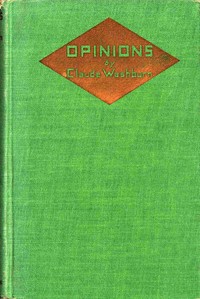
Opinions — Reading Notes
(0 User reviews)
393
Project Gutenberg
2023
Not confirmed
American essays -- 20th century
Readers of public-domain and historical texts
Project Gutenberg digital edition
en
Edition facts
Words
51,891
Reading time
226 min
Text sections
5
The source record for Opinions — Reading Notes measures this digital text at 51,891 words, 3 hr 46 min estimated reading time, and 5 detected text sections.
The text analysis averages about 22.0 words per sentence, while the detected sections provide another way to judge how the source is divided.
Project Gutenberg metadata also associates the work with “American essays -- 20th century,” connecting these edition facts with the source record’s subject description.
Source:
Project Gutenberg record #70465
Claude Washburn's 1926 essay collection uses a preface as its first essay, then moves through topics like Italian prose style, American business, and literary immortality, with a self-deprecating, conversational tone and recurring attention to the mechanics of writing.
Editorial Edition Score
4.7/5
★★★★★
★★★★★
Calculated from edition completeness, EPUB availability, text structure and catalogue metadata. Not a user rating.
How this score is calculated
- Description quality20 pts
- Title & short description10 pts
- Source metadata20 pts
- Text length15 pts
- Chapters / structure15 pts
- EPUB file integrity20 pts
Total of 100 points, scaled to a 2.5-5.0 range. Editions with an empty description or a missing EPUB file are not scored.
Edition quality
Public-domain source text
Read the source text
The source text is kept in the dedicated reader, separate from this catalogue record and its commentary.
The preface of Opinions is itself an essay, and Washburn insists it be read first. He frames opinions as troublesome sediment that must be flushed out through writing, not conversation. This opening establishes a voice that is wry, self-aware, and skeptical of literary pretension. The collection then moves through a series of loosely connected essays, each anchored by a specific observation or anecdote rather than a thesis. Washburn’s method is associative: a remark about Italian prose leads to a digression on Harvard composition courses, then to the sentimentality of Cuore, and finally to the odd popularity of boxing in Italy. The structure is cumulative, not argumentative.
The Preface as Performance
Washburn’s preface does more than introduce; it enacts the book’s central conceit. He calls it “the shortest” essay and a quick test of whether to borrow the volume. This self-deprecating frame is consistent throughout: he admits novelists are “not among the most veracious of people” and that opinions, once printed, may cease to be believed even by their author. The preface also introduces a recurring image—opinions as “clogging sediment in a water-pipe”—that grounds abstract reflection in a concrete, almost mechanical metaphor. Washburn’s tone is conversational, but his structure is deliberate: he loops back to the difficulty of ridding oneself of opinions, then undercuts the whole enterprise by doubting that any writer’s opinions have real effect. The preface thus functions as both a genuine essay and a playful disclaimer.
Italian Prose and the Weight of Models
In the excerpt on Italian composition, Washburn contrasts his own Harvard training—“say what you have to say, if anything, in as few words as possible”—with Italian schools that prescribe florid models like Manzoni and De Amicis. He calls Cuore “obscene” for its forced sentimentality, and cites a mother proudly showing him a letter from her daughter that reads, “Beloved Mamma ... I think of you always, always.” The example is specific and damning. Washburn’s critique is not merely aesthetic; it is structural. He argues that this methodical corruption produces a prose style “hopelessly verbose and weighted with rhetorical emotional platitudes.” The passage moves from a personal anecdote about Harvard to a broader cultural observation, then back to a concrete instance—a pattern that recurs throughout the collection.
American Business and Italian Taste
Washburn’s eye for incongruity appears in his aside about an American five-and-ten-cent store in Italy. He imagines “a full-blooded corkscrew at two lire, a hearty can-opener at one lira” selling briskly, and notes that Italians pore over Saturday Evening Post advertisements. The observation is tossed off, but it reveals a method: Washburn moves from a specific, almost absurd image to a larger point about cultural inconsistency. He does not argue systematically; instead, he lets the image carry the weight. This associative structure gives the essays a conversational rhythm, but it also means that transitions can feel abrupt. The reader must follow the thread of Washburn’s attention, which shifts from Italian prose to American commerce without explicit signposting.
Self-Deprecation as a Structural Device
Throughout the excerpts, Washburn undercuts his own authority. He calls novelists “not among the most veracious of people,” admits that his Harvard training left him with “an almost guilty feeling,” and speculates that literary immortality is a myth—except for the Tauchnitz Edition. This self-deprecation is not merely tonal; it structures the argument. By doubting his own influence, Washburn frees himself to make sweeping claims without appearing dogmatic. The preface’s claim that opinions must be “embalmed in print” to be released is itself offered as a mystery. The essays thus proceed by indirection, building credibility through confessed limitation. Readers should expect a voice that is authoritative in its observations but skeptical of its own conclusions.
Washburn’s Opinions rewards a reader willing to follow digressions. The essays are best approached not as arguments but as performances—each one a demonstration of how a mind moves from a specific detail to a general reflection. Pay attention to the images: the water-pipe, the corkscrew, the Harvard red marks. They are the anchors that keep the prose from drifting into abstraction. The collection’s structure is loose, but its voice is consistent: wry, precise, and unafraid to contradict itself.
That rainy afternoon, Claude Washburn’s habit of turning even a preface into an essay made me linger over the mechanics of a writer’s self-regard. His gentle mockery of permanence left me wondering how another restless soul handled fame. So I drifted to the fourth volume of his letters, Life of Lord Byron, Vol. 4 With His Letters and Journals — A Reader’s Guide, and found a similar, quiet ache.
There are no reviews for this eBook.
There are no comments for this eBook.
Reader reflection
Your personal reading reflection
Build a private reading journal entry for this title.
Your progress
0
/
10
2
Was reading this book enjoyable?
3
Would you pass this book on to a friend?
4
How demanding did the text feel?
5
Did you gain anything practical from the text?
6
How personally connected did you feel to the book?
7
How did the reading compare with what you expected?
8
How would you describe its reading pace?
9
What is the main idea you are taking away?
10