1

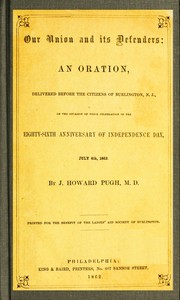
Our Union and Its Defenders An Oration, Delivered Before the Citizens of Burlington, N.J., on the Occasion of Their Celebration of the Eighty-Sixth Anniversary of — A Closer Reading
(0 User reviews)
129
Project Gutenberg
2019
Not confirmed
Fourth of July orations; United States -- History -- Civil War, 1861-1865 -- Religious aspects
Readers of public-domain and historical texts
Project Gutenberg digital edition
en
Edition facts
Words
10,594
Reading time
47 min
Text sections
3
The source record for Our Union and Its Defenders An Oration, Delivered Before the Citizens of Burlington, N.J., on the Occasion of Their Celebration of the Eighty-Sixth Anniversary of — A Closer Reading measures this digital text at 10,594 words, 47 min estimated reading time, and 3 detected text sections.
The text analysis averages about 27.2 words per sentence, while the detected sections provide another way to judge how the source is divided.
Project Gutenberg metadata also associates the work with “Fourth of July orations,” connecting these edition facts with the source record’s subject description.
Source:
Project Gutenberg record #59890
A July 4th, 1862 oration by Dr. J. Howard Pugh in Burlington, N.J., arguing for Union loyalty during the Civil War, warning against militarism, and predicting Southern return after military defeat.
Editorial Edition Score
4.5/5
★★★★★
★★★★★
Calculated from edition completeness, EPUB availability, text structure and catalogue metadata. Not a user rating.
How this score is calculated
- Description quality20 pts
- Title & short description10 pts
- Source metadata20 pts
- Text length15 pts
- Chapters / structure15 pts
- EPUB file integrity20 pts
Total of 100 points, scaled to a 2.5-5.0 range. Editions with an empty description or a missing EPUB file are not scored.
Edition quality
Public-domain source text
Read the source text
The source text is kept in the dedicated reader, separate from this catalogue record and its commentary.
Dr. J. Howard Pugh delivered this oration on July 4, 1862, in Burlington, New Jersey, at a moment when the Civil War had been raging for over a year. The text, published later that year by King & Baird, preserves the speech as a document of Northern Unionist sentiment. Pugh, a physician, frames his argument around the necessity of preserving the Union while cautioning against the long-term dangers of militarism. The oration is notable for its dual focus: defending the Northern war effort and speculating on the conditions under which the South might return to allegiance.
A Warning Against Military Power
Pugh devotes a substantial passage to the risks posed by large standing armies and prolonged war. He argues that military establishments consume national resources and paralyze industry, and that the qualities making great generals are not those that foster respect for individual rights. He asserts that no American general could establish a dictatorship because the people remember Washington's example of relinquishing power. However, he warns that if the nation leans on the military for half a century, with recurring wars absorbing liberty of thought and speech, Americans might seek stability at the expense of liberty. This argument is grounded in the specific historical context of 1862, not in abstract theory.
Predicting Southern Reconciliation
Pugh expresses confidence that the South's military power can be broken, and that once it is, the region will return to allegiance. He lists conditions for this: crushing political and military leaders, stopping systematic lying, and allowing time for cooling and consideration. He contrasts the South with oppressed nationalities like Poland or Hungary, noting that the South shares race, language, religion, and a reasonable cause is absent. He claims the masses were never convinced secession was right, and that leaders initially sought a new constitution, not permanent separation. These claims reflect Pugh's Northern perspective and are not corroborated by Southern sources in the excerpts.
The Oration's Occasion and Publication
The pamphlet includes a letter from Burlington citizens requesting publication, signed by Franklin Woolman, Thomas Robb, and others. They praise the address as appropriate and impressive, and wish to disseminate it to strengthen convictions. Pugh's reply expresses hope that the oration might enlighten patriotism, though he fears its usefulness falls short of their wishes. This exchange frames the speech as a deliberate piece of war propaganda, intended to bolster Union morale. The publication date—1862, during the war—underscores its immediate political purpose, rather than a retrospective analysis.
Readers should approach this oration as a primary source from the Civil War home front, not as a comprehensive history. Pugh's arguments reveal Northern anxieties about both the rebellion and the potential erosion of republican institutions. The text is brief, under 11,000 words, and can be read in under an hour. Pay attention to how Pugh balances patriotic fervor with cautionary notes, and consider the audience of Burlington citizens who requested its publication.
There’s something haunting about reading that July 1862 oration—the way Dr. Pugh insisted the South would return, as if the Union’s wound could heal by sheer insistence. It reminded me of how The collected works of William Hazlitt, Vol. 09 (of 12) — Text and Context lingers on hope’s stubbornness, its refusal to look at the gunsmoke. History’s optimists always break my heart a little.
There are no reviews for this eBook.
There are no comments for this eBook.
Reader reflection
How will you remember this book?
Save your reaction, strongest insight, and memorable passage.
Your progress
0
/
10
2
How much did you enjoy the reading experience?
3
Would you pass this book on to a friend?
4
What was the reading difficulty like?
5
Did the story or argument move comfortably?
6
Which aspect of the book did you value most?
7
Did the book deliver what you hoped for?
8
Is this a title worth rereading?
9
What did this book teach you most?
10