1

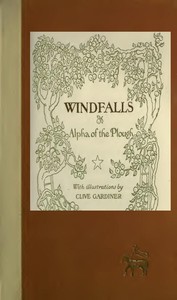
Windfalls — A Reader’s Guide
(0 User reviews)
591
Project Gutenberg
2014
Not confirmed
English essays -- 20th century
Readers of public-domain and historical texts
Project Gutenberg digital edition
en
Edition facts
Words
68,667
Reading time
299 min
Text sections
10
The catalog record for Windfalls — A Reader’s Guide provides practical reading context through 68,667 words, 4 hr 59 min estimated reading time, and 10 detected text sections.
The text analysis averages about 20.2 words per sentence, while the detected sections provide another way to judge how the source is divided.
Project Gutenberg metadata also associates the work with “English essays -- 20th century,” connecting these edition facts with the source record’s subject description.
Source:
Project Gutenberg record #47429
A collection of essays by A. G. Gardiner, writing as 'Alpha of the Plough,' exploring everyday life with wit and reflection. The author's voice is conversational, often addressing the reader directly, and the pieces range from observations on bees and wasps to meditations on truth, habits, and idleness.
Editorial Edition Score
4.8/5
★★★★★
★★★★★
Calculated from edition completeness, EPUB availability, text structure and catalogue metadata. Not a user rating.
How this score is calculated
- Description quality20 pts
- Title & short description10 pts
- Source metadata20 pts
- Text length15 pts
- Chapters / structure15 pts
- EPUB file integrity20 pts
Total of 100 points, scaled to a 2.5-5.0 range. Editions with an empty description or a missing EPUB file are not scored.
Edition quality
Public-domain source text
Read the source text
The source text is kept in the dedicated reader, separate from this catalogue record and its commentary.
In the preface to Windfalls, A. G. Gardiner describes his essays as fruit gathered from a modest orchard, and the metaphor suits the collection's unhurried, observational tone. The opening essay, 'Jemima,' introduces a duck whose name, the author confesses, was a christening accident—a detail that sets the stage for Gardiner's fondness for the quirks of domestic life. He writes in a conversational style, often breaking off to address the reader directly ('Dear madam (or sir)'), and his sentences meander with the ease of a spoken anecdote.
The Author's Conversational Voice
Gardiner's essays read like extended asides delivered to a friend. He frequently uses parentheses and dashes to insert afterthoughts, as when he notes that Jemima was 'the victim of an accident at the christening ceremony.' The tone is intimate and self-deprecating; he admits to being 'a timid person' when recounting the story of a reporter wrongly accused of theft. This direct address—'You will have observed that I have twice referred to Jemima in the masculine gender'—creates a sense of shared amusement. The essays are structured around small incidents: digging artichokes, observing a swarm, or recalling a dinner. Gardiner's voice is the unifying thread, turning the mundane into material for reflection.
Truth and Its Many Sides
Several essays grapple with the elusiveness of truth. Gardiner uses the handkerchief incident in Othello to illustrate how isolated facts can mislead: 'Desdemona could not produce the handkerchief. That was the fact that the Moor saw.' He then recounts a real-life case from Fleet Street where a reporter's pawn tickets were mistaken for evidence of theft. The essay 'On Facts and the Truth' argues that 'a fact that is only half the truth (or a quarter) is the most dangerous lie.' Gardiner quotes Ruskin's remark that he is 'never satisfied that I have handled a subject properly till I have contradicted myself three times.' This theme recurs across the collection, urging readers to distrust easy conclusions.
Observations on Nature and Domestic Life
Gardiner's essays often begin with a simple outdoor activity—digging artichokes, watching bees, or sitting under a sycamore. In 'Jemima,' the duck's family of Indian runners follows him 'in single file' with 'a gabble of merry noises.' The author's attention to animal behavior is precise: Jemima is 'first into the breach' when the fork appears. Elsewhere, he defends wasps against common prejudice and reflects on the habits of bees. These pieces are not scientific but personal; they record what catches the eye during a quiet afternoon. The setting is an English orchard, and the essays capture the rhythms of a rural life that is unhurried and attentive to small details.
The Structure of the Collection
The book's table of contents lists over forty essays, each with a title that signals a topic: 'On Being Idle,' 'On Habits,' 'On Great Replies,' 'On a Hansom Cab.' The range is deliberately miscellaneous, as the preface acknowledges: the essays are 'windfalls' gathered from a 'modest orchard.' Gardiner writes under the pseudonym 'Alpha of the Plough,' and the pieces originally appeared in periodicals. The collection is not arranged by theme but by the associative logic of a leisurely mind. Readers familiar with the essay tradition will recognize the influence of Montaigne and Lamb, but Gardiner's voice is distinctly his own—wry, humane, and skeptical of certainty.
Gardiner's essays reward the reader who savors digression. The collection is best approached not as a sustained argument but as a series of conversations, each starting from a concrete image—a duck, a knife, a swarm of bees—and spiraling outward into reflection. The author's willingness to contradict himself and to question the sufficiency of facts makes these pieces feel alive to the complexity of experience. Read them in any order; the pleasure lies in the voice.
I found myself returning to Windfalls the other evening, particularly that gentle piece on idleness, and it stirred a quieter memory. There is a certain unhurried thread there, a way of sitting with one’s own thoughts, that I felt again elsewhere. It made me think of The Thread of Gold — A Closer Reading, which holds a similar, patient warmth, like sun on a dusty windowsill.
There are no reviews for this eBook.
There are no comments for this eBook.
Reader reflection
How did this book work for you?
Your answers remain private and are stored only in this browser.
Your progress
0
/
10
2
How much did you enjoy the reading experience?
3
Would you pass this book on to a friend?
4
How demanding did the text feel?
5
Did any part of the book feel personally relevant?
6
How valuable was this book for your own interests?
7
Did the book meet your expectations?
8
Did anything about the book feel genuinely new?
9
Which lesson or insight stayed with you?
10