1

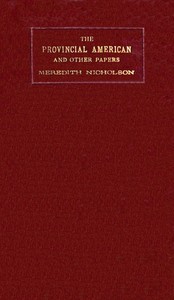
The provincial American and other papers — Text and Context
(0 User reviews)
121
Project Gutenberg
2022
Not confirmed
American essays -- 20th century
Readers of public-domain and historical texts
Project Gutenberg digital edition
en
Edition facts
Words
45,219
Reading time
197 min
Text sections
14
For The provincial American and other papers — Text and Context, the stored edition analysis reports 45,219 words, 3 hr 17 min estimated reading time, and 14 detected text sections.
The text analysis averages about 25.4 words per sentence, while the detected sections provide another way to judge how the source is divided.
Project Gutenberg metadata also associates the work with “American essays -- 20th century,” connecting these edition facts with the source record’s subject description.
Source:
Project Gutenberg record #68318
Meredith Nicholson's 1912 essays examine the provincial American identity through personal experience, contrasting Midwestern and Eastern sensibilities, and addressing religion, literature, and social change with a wry, self-aware voice.
Editorial Edition Score
4.8/5
★★★★★
★★★★★
Calculated from edition completeness, EPUB availability, text structure and catalogue metadata. Not a user rating.
How this score is calculated
- Description quality20 pts
- Title & short description10 pts
- Source metadata20 pts
- Text length15 pts
- Chapters / structure15 pts
- EPUB file integrity20 pts
Total of 100 points, scaled to a 2.5-5.0 range. Editions with an empty description or a missing EPUB file are not scored.
Edition quality
Public-domain source text
Read the source text
The source text is kept in the dedicated reader, separate from this catalogue record and its commentary.
Meredith Nicholson opens the title essay by declaring himself a provincial American, tracing his lineage through Virginia, North Carolina, Pennsylvania, and Kentucky before settling in Indiana. He notes that he had voted before seeing the sea or any Eastern city, grounding his perspective in a specific geography of inland experience. The collection, originally published in the Atlantic Monthly, includes pieces on the novelist Edward Eggleston, a provincial capital (likely Indianapolis), and the tensions between religious faith and modern doubt. Nicholson’s voice is self-deprecating yet assured, as when he quotes George Ade’s remark that Purdue offers everything Harvard does “except the sound of a as in ‘father.’”
The Provincial as a Conscious Identity
Nicholson does not merely describe provincialism; he performs it. In the opening essay, he admits that anywhere east of Buffalo he would be known as a Westerner and that he cannot disguise himself if he would. This awareness of being marked by speech and origin recurs throughout the volume. He writes that he is “most comfortable in a town whose population does not exceed a fif” (the excerpt cuts off), suggesting a deliberate preference for smaller scales. The provincial, for Nicholson, is not a figure of shame but of chosen limitation. He aims to “cheer many who, flung by fate upon the world’s byways, shuffle and shrink under the reproach of their metropolitan brethren.” The tone is both defensive and rallying, a kind of manifesto for those who stay put.
Religion and the Practical Smith
In “Should Smith go to Church?” Nicholson invents a representative figure named Smith, a skeptical everyman uninterested in theological disputes. Smith, Nicholson argues, is not moved by “scholarly discussion of doubtful texts” or the decisions of the Council of Nicæa. What Smith needs is a Christianity stripped to essentials: Christ’s own words in black-face type, a “working platform for the guidance of men.” Nicholson criticizes churches that pursue heretics while ignoring social evils, and praises clergymen who practice “courage” in social service. The essay balances a defense of biblical criticism with a pragmatic call for relevance. The Smiths of the world, Nicholson insists, admire courage in politics and would rally to a religion that practices it undauntedly.
Literary Forebears and Regional Roots
The essay on Edward Eggleston places Nicholson in a lineage of Midwestern writers. Eggleston, known for The Hoosier Schoolmaster, is treated as a pioneer who brought regional material to national attention. Nicholson’s own project echoes this: he writes from Indianapolis, a “provincial capital,” and dedicates the book to George Edward Woodberry, a critic and friend. The dedication, dated September 1912 in Indianapolis, anchors the collection in a specific place and time. Nicholson’s essays are not abstract; they emerge from a particular soil. Even the dialogue “The Spirit of Mischief” and the self-mocking “Confessions of a ‘Best-Seller’” suggest a writer aware of his audience and his own position between the local and the national.
Readers will find that Nicholson’s essays reward attention to his recurring rhetorical moves: the use of a representative figure (Smith), the invocation of personal history as evidence, and the careful negotiation between defense of the provincial and critique of its limitations. The collection is best approached not as a unified argument but as a series of performances of a particular American voice—one that knows itself to be marked by region and uses that marking as a lens for examining broader questions of faith, culture, and belonging.
There’s a moment in Nicholson’s essays where the Midwest feels less like a place and more like a mood—that quiet, wry ache for something half-remembered. It reminds me of another collection I keep nearby, Historical Essays — Story, Setting & Ideas, where the past doesn’t lecture, just lingers. I find myself rereading both on slow evenings, the way one returns to an old photograph.
There are no reviews for this eBook.
There are no comments for this eBook.
Reader reflection
What did you think of this book?
Answer a few questions and save a private reflection on this device.
Your progress
0
/
10
2
Was reading this book enjoyable?
3
Would you recommend this book to another reader?
4
What was the reading difficulty like?
5
Would you start a conversation about this book?
6
Did this book create an emotional response?
7
Would a second reading be valuable?
8
Which element worked best for you?
9
What is the main idea you are taking away?
10