1

Essays on Mankind and Political Arithmetic — A Closer Reading
(0 User reviews)
629
Project Gutenberg
2004
Not confirmed
Population; London (England) -- Population
Readers of public-domain and historical texts
Project Gutenberg digital edition
en
Edition facts
Words
32,859
Reading time
143 min
Text sections
5
The catalog record for Essays on Mankind and Political Arithmetic — A Closer Reading provides practical reading context through 32,859 words, 2 hr 23 min estimated reading time, and 5 detected text sections.
The text analysis averages about 29.6 words per sentence, while the detected sections provide another way to judge how the source is divided.
Project Gutenberg metadata also associates the work with “Population,” connecting these edition facts with the source record’s subject description.
Source:
Project Gutenberg record #5619
Sir William Petty's 17th-century essays apply quantitative reasoning to population, housing, and mortality in London, using parish records, hearth taxes, and plague data to estimate city size and growth.
Editorial Edition Score
4.7/5
★★★★★
★★★★★
Calculated from edition completeness, EPUB availability, text structure and catalogue metadata. Not a user rating.
How this score is calculated
- Description quality20 pts
- Title & short description10 pts
- Source metadata20 pts
- Text length15 pts
- Chapters / structure15 pts
- EPUB file integrity20 pts
Total of 100 points, scaled to a 2.5-5.0 range. Editions with an empty description or a missing EPUB file are not scored.
Edition quality
Public-domain source text
Read the source text
The source text is kept in the dedicated reader, separate from this catalogue record and its commentary.
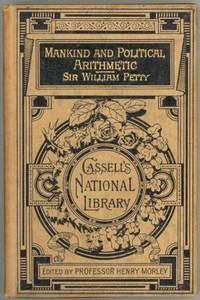
Sir William Petty's Essays on Mankind and Political Arithmetic opens with a biographical introduction by Henry Morley, tracing Petty's education at Caen, Utrecht, Leyden, and Amsterdam, and his early inventions such as a copying machine. The essays themselves, however, are not biographical. They are exercises in what Petty calls "political arithmetic": the use of numerical data to analyze social and economic conditions. The excerpts focus on London's population in the late 1600s, drawing on parish burial records, hearth tax returns, and plague mortality figures.
Counting Houses and Hearth Taxes
Petty employs multiple methods to estimate the number of houses in London. He cites the 13,200 houses burned in the Great Fire of 1666, then uses burial ratios to project housing totals for 1686. He also references a map from 1682 that counted above 84,000 houses, and hearth tax data from Dublin and Bristol to cross-check London's figures. The hearth tax returns show 388,000 hearths in London, which Petty converts into house counts using ratios from other cities: Dublin yields 87,000 houses, Bristol 123,000. He settles on a medium estimate of 105,000 houses, later confirmed by a certificate from the hearth office. This triangulation of sources reveals Petty's method: no single dataset is trusted alone.
Plague Mortality as a Census Tool
Petty uses plague deaths to estimate total population. He notes that in Nero's time, 300,000 died of plague in Rome, and if three of ten died then (versus two of ten in London), Rome's population was about one million. London's plague deaths are then compared to infer its population of roughly 700,000. He also compares the built areas: Rome's walled area of about seven square miles plus suburbs totals thirteen square miles, while London's built ground is about nine square miles. The ratios of area and population align, leading Petty to conclude that old Rome was "half as big again" as contemporary London. This reasoning shows how Petty uses historical parallels to validate his estimates.
Households and Heads per Family
Petty estimates the number of families per house and heads per family. He suggests that in Paris there might be three or four families per house, while in London about one-tenth of houses contain two families. For heads per family, he relies on John Graunt's observation that tradesmen's families average eight persons, higher ranks above ten, and the poorest near five. Petty had previously calculated a national average of six and one-third heads per family, but for London he adopts a different figure, agreeing with "Monsieur Auzout" (likely the French astronomer Adrien Auzout). This section illustrates Petty's willingness to adjust assumptions based on local data and expert opinion.
Petty's essays are best read as a demonstration of method rather than a definitive census. His willingness to combine disparate sources—hearth taxes, burial records, maps, and foreign comparisons—shows a mind intent on extracting order from imperfect data. Readers should note that Petty often states his assumptions explicitly, making his reasoning transparent even when his numbers are rough. The essays reward attention to his arithmetic steps and his candid acknowledgment of uncertainty.
Petty counting plague deaths and hearths made me think of my grandmother’s old ledger, how she tracked harvest yields. That quiet arithmetic felt like love. Reading his dry tables stirred something tender, the way African and European Addresses — Themes and Context once did, showing me that numbers and words alike hold a people’s pulse, softly, insistently.
There are no reviews for this eBook.
There are no comments for this eBook.
Reader reflection
Before you leave, reflect on the book
Use these questions to collect your thoughts before moving on.
Your progress
0
/
10
2
What was your overall reaction to the book?
3
Would you pass this book on to a friend?
4
What was the reading difficulty like?
5
How distinctive were its ideas or approach?
6
Was the book easy to understand?
7
How useful did the reading feel?
8
What did you appreciate most?
9
In one sentence, what did you learn?
10