1

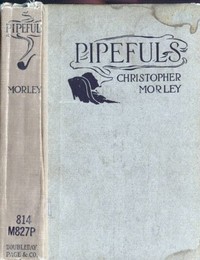
Pipefuls — Context and Discussion
(0 User reviews)
278
Project Gutenberg
2007
Not confirmed
Essays
Readers of public-domain and historical texts
Project Gutenberg digital edition
en
Edition facts
Words
59,938
Reading time
261 min
Text sections
9
The source record for Pipefuls — Context and Discussion measures this digital text at 59,938 words, 4 hr 21 min estimated reading time, and 9 detected text sections.
The text analysis averages about 20.5 words per sentence, while the detected sections provide another way to judge how the source is divided.
Project Gutenberg metadata also associates the work with “Essays,” connecting these edition facts with the source record’s subject description.
Source:
Project Gutenberg record #22699
Christopher Morley's 1920 essay collection uses the pipe as a framing device for sketches that move from bookshops to train stations, blending self-deprecating humor with sharp observations of early 20th-century American life.
Editorial Edition Score
4.7/5
★★★★★
★★★★★
Calculated from edition completeness, EPUB availability, text structure and catalogue metadata. Not a user rating.
How this score is calculated
- Description quality20 pts
- Title & short description10 pts
- Source metadata20 pts
- Text length15 pts
- Chapters / structure15 pts
- EPUB file integrity20 pts
Total of 100 points, scaled to a 2.5-5.0 range. Editions with an empty description or a missing EPUB file are not scored.
Edition quality
Public-domain source text
Read the source text
The source text is kept in the dedicated reader, separate from this catalogue record and its commentary.
Christopher Morley's Pipefuls (1920) is a collection of essays that originally appeared in newspapers like The New York Evening Post and The Philadelphia Evening Public Ledger. The title itself suggests a leisurely, contemplative reading—each piece meant to be consumed with a pipe of tobacco. Morley's preface sets a self-deprecating tone, acknowledging the sketches as 'slattern paragraphs' written under deadline pressure. The book's structure is loose, moving from personal reflections to urban vignettes, with recurring attention to the rhythms of city life and the quirks of human behavior.
The Pipe as a Structural Device
The title Pipefuls is not merely decorative; it signals a deliberate pacing. Morley frames each essay as a brief, smoke-filled interlude, meant to be savored rather than rushed. This structure allows him to shift abruptly between subjects—from the mechanics of moving house to the etiquette of buying a meal—without needing a unifying thesis. The pipe becomes a metaphor for the essayist's craft: a series of small, contained pleasures that together form a larger portrait of the author's mind. Morley's preface reinforces this, noting that none of the pieces 'are so long that they may not be mitigated by an accompanying pipe of tobacco.' The reader is invited to dip in and out, mirroring the casual, episodic nature of the original newspaper columns.
Recurring Images: The City in Motion
Throughout the excerpts, Morley returns to images of transit and urban flux. In 'The Owl Train,' he captures the eerie quiet of late-night rail travel; in 'Tales of Two Cities,' he contrasts Philadelphia's early morning trains with New York's bustling streets. The city is a living organism, and Morley positions himself as a flâneur, observing its rhythms. A particularly vivid passage describes Mayor Smith's 'nicely draped trouserings' quivering as he introduces General Pershing. These small, physical details—a quivering trouser leg, a nervous hand gesture—anchor the essays in a specific, tangible world. Morley's eye for the telling gesture, like Pershing's 'clenching and unclenching of his hands,' turns public events into intimate portraits.
Movement Between Scenes: From the Mundane to the Momentous
Morley's essays often begin with a trivial observation—a safety pin, a cider press—and spiral outward into broader reflections. In 'Fall Fever,' he starts with the 'mellow air' of autumn and moves through literary allusions (Keats, the cave man) to a wry comment on Judge Audenried's sleeping clerks. This associative structure mimics the wandering mind, allowing Morley to juxtapose high and low culture without pretension. The movement is not linear but circular: he returns to the same themes—the press of deadlines, the solace of books, the absurdity of modern life—across multiple pieces. This repetition creates a cohesive voice, even as the settings shift from a bookshop to a beach to a political rally.
The Essayist as Observer and Participant
Morley rarely positions himself as a neutral observer. In the Pershing sketch, he admits to liking the general for his verbal stumbles—'pattriotic' and 'patterotism'—and for his modesty. This personal intrusion is characteristic: Morley is always present in his essays, offering opinions, confessing his own fallibility. In 'Confessions of a Colyumist,' he jokes about the pain of writing, and in the preface, he claims the sketches 'gave me pain to write; they will give the judicious patron pain to read.' This self-mockery disarms criticism and invites the reader into a conspiratorial relationship. Yet Morley is also a sharp social critic, noting the gap between public rhetoric and private reality, as when Pershing's slip about 'our Allies' draws a ripple of laughter that the general himself misses.
Readers approaching Pipefuls should treat it as a series of discrete encounters rather than a sustained argument. The essays reward dipping in at random, letting Morley's voice carry the day. Pay attention to the small details—the quivering trouser leg, the mispronounced word—for they are where the collection's true texture lies. Morley's world is one of newspapers, bookshops, and train stations, but his observations transcend their moment, offering a wry, humane perspective on the everyday.
There’s something about Morley’s pipe-lit wanderings that feels like sitting quietly on a platform, watching trains leave without you. That same unhurried ache of places observed from a slight distance threads through African and European Addresses — Themes and Context. I kept thinking of how both books hold a warmth that never asks for anything in return, just lingers.
There are no reviews for this eBook.
There are no comments for this eBook.
Reader reflection
What was your reading experience?
Capture what you thought, learned, and would like to remember.
Your progress
0
/
10
2
Was reading this book enjoyable?
3
Is this a title you would suggest to others?
4
How much effort did this book require?
5
How useful were the ideas in this book?
6
How understandable was the text?
7
Do you expect to return to this book?
8
Did any part of the book feel personally relevant?
9
What did this book teach you most?
10