1

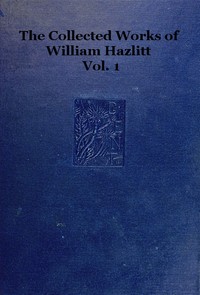
The collected works of William Hazlitt, Vol. 01 (of 12) — A Closer Reading
(0 User reviews)
266
Project Gutenberg
2017
Not confirmed
English essays -- 19th century
Readers of public-domain and historical texts
Project Gutenberg digital edition
en
Edition facts
Words
217,134
Reading time
945 min
Text sections
33
For The collected works of William Hazlitt, Vol. 01 (of 12) — A Closer Reading, the stored edition analysis reports 217,134 words, 15 hr 45 min estimated reading time, and 33 detected text sections.
The text analysis averages about 22.7 words per sentence, while the detected sections provide another way to judge how the source is divided.
Project Gutenberg metadata also associates the work with “English essays -- 19th century,” connecting these edition facts with the source record’s subject description.
Source:
Project Gutenberg record #55932
This first volume of a twelve-volume collected edition opens with a biographical introduction by W. E. Henley, then presents Hazlitt's early essays from 'The Round Table,' his landmark 'Characters of Shakespear's Plays,' and the polemical 'A Letter to William Gifford, Esq.' The excerpts reveal Hazlitt's combative prose, psychological insight into Shakespeare's characters, and the editorial framing of his reputation.
Editorial Edition Score
4.9/5
★★★★★
★★★★★
Calculated from edition completeness, EPUB availability, text structure and catalogue metadata. Not a user rating.
How this score is calculated
- Description quality20 pts
- Title & short description10 pts
- Source metadata20 pts
- Text length15 pts
- Chapters / structure15 pts
- EPUB file integrity20 pts
Total of 100 points, scaled to a 2.5-5.0 range. Editions with an empty description or a missing EPUB file are not scored.
Edition quality
Public-domain source text
Read the source text
The source text is kept in the dedicated reader, separate from this catalogue record and its commentary.
W. E. Henley's introduction to this 1902 collected edition immediately frames William Hazlitt as a writer defined by 'a fine pugnaciousness of mind' and 'a fiery courage.' Henley dwells on Hazlitt's reputation among contemporaries, who, he claims, sought to present him as a public enemy. The editorial apparatus thus sets the stage for a writer whose literary merits were long contested.
The volume itself gathers three distinct works: the periodical essays of The Round Table, the critical studies in Characters of Shakespear's Plays, and the polemical A Letter to William Gifford, Esq. This combination showcases Hazlitt's range from reflective criticism to direct political attack.
Henley's Portrait of a Polemicist
Henley's introduction is less a neutral biography than a defense of Hazlitt against his detractors. He attributes Hazlitt's combative style to his lineage—a father who was a Unitarian minister and an Antrim dissenter—and claims this background produced a writer 'unequalled in his time' for 'brilliancy in the use of his hands.' The language is itself pugnacious: Henley describes Hazlitt's opponents as 'the powers that were' who 'did their utmost to dissemble his uncommon merits.'
Henley singles out Hazlitt's admiration for Napoleon—'the Corsican fiend'—as a particular cause of execration. This biographical framing primes the reader to see Hazlitt as a writer whose critical judgments were inseparable from his political stances.
Hazlitt on Hamlet: Criticism as Identification
In Characters of Shakespear's Plays, Hazlitt's approach to Hamlet is notably personal. He writes that 'It is we who are Hamlet,' and describes the character's reality as 'in the reader's mind.' This psychological identification is central to his method: he lists the experiences that make one 'the true Hamlet'—'the pangs of despised love,' 'the insolence of office,' 'the spurns which patient merit of the unworthy takes.'
Hazlitt avoids plot summary, instead treating the play as a repository of 'striking reflections on human life.' His criticism is impressionistic, grounded in the emotional effect of the drama rather than in textual analysis. The excerpt shows him weaving quotations into his own prose, as when he echoes Hamlet's 'too much i' th' sun' and the 'goodly frame, the earth, a steril promontory.'
The Texture of Hazlitt's Prose in Antony and Cleopatra
Hazlitt's commentary on Antony and Cleopatra demonstrates his sensitivity to poetic language. He singles out Antony's speech beginning 'The rack dislimns, and makes it indistinct / As water is in water' as 'one of the finest pieces of poetry in Shakespear.' His analysis focuses on the imagery's 'semblance of reality' and 'evanescent nature,' which he compares to 'the mouldering schemes of human greatness.'
He also highlights the repentance of Enobarbus as 'the most affecting part of the play,' noting that Enobarbus dies 'broken-hearted, a master-leaver and a fugitive.' Hazlitt's final image—that Shakespeare's 'genius has spread over the whole play a richness like the overflowing of the Nile'—is characteristic of his critical style: metaphorical, vivid, and grounded in the text's own imagery.
Readers approaching this volume should note that the excerpts represent only a fraction of Hazlitt's output. The Round Table essays and the Letter to William Gifford are not sampled here, so the full range of his social and political commentary remains to be explored. Henley's introduction, while informative, is itself a partisan document; comparing it with Hazlitt's own prose offers insight into how literary reputations are constructed.
Reading Hazlitt’s fierce, personal essays felt like sitting with a friend who thinks aloud. His sharpness on Shakespeare lingers, a kind of quiet ache for how we judge art. That same thoughtful, wandering intimacy lives in this collection of Howells’ notes—not a conclusion, just a shared afterglow. Complete Project Gutenberg William Dean Howells Literature Essays — Reading Notes reminds me of that, somehow.
There are no reviews for this eBook.
There are no comments for this eBook.
Reader reflection
Your personal reading reflection
Build a private reading journal entry for this title.
Your progress
0
/
10
2
Was reading this book enjoyable?
3
Is this a title you would suggest to others?
4
How demanding did the text feel?
5
What did you appreciate most?
6
How closely did the book connect with your experience?
7
How did the reading compare with what you expected?
8
Was the book easy to understand?
9
In one sentence, what did you learn?
10