1

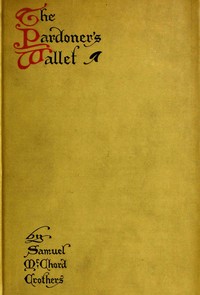
The Pardoner's Wallet — A Reader’s Guide
(0 User reviews)
1049
Project Gutenberg
2024
Not confirmed
American essays -- 20th century
Readers of public-domain and historical texts
Project Gutenberg digital edition
en
Edition facts
Words
60,584
Reading time
264 min
Text sections
15
The catalog record for The Pardoner's Wallet — A Reader’s Guide provides practical reading context through 60,584 words, 4 hr 24 min estimated reading time, and 15 detected text sections.
The text analysis averages about 18.2 words per sentence, while the detected sections provide another way to judge how the source is divided.
Project Gutenberg metadata also associates the work with “American essays -- 20th century,” connecting these edition facts with the source record’s subject description.
Source:
Project Gutenberg record #73172
Samuel McChord Crothers's 1905 essay collection uses the persona of a pardoner to examine human foibles with wit and charity. The essays explore unseasonable virtues, prejudices, fallacies, and the difficulty of peacemaking, all marked by a conversational, ironic voice that shifts between playful satire and earnest reflection.
Editorial Edition Score
4.8/5
★★★★★
★★★★★
Calculated from edition completeness, EPUB availability, text structure and catalogue metadata. Not a user rating.
How this score is calculated
- Description quality20 pts
- Title & short description10 pts
- Source metadata20 pts
- Text length15 pts
- Chapters / structure15 pts
- EPUB file integrity20 pts
Total of 100 points, scaled to a 2.5-5.0 range. Editions with an empty description or a missing EPUB file are not scored.
Edition quality
Public-domain source text
Read the source text
The source text is kept in the dedicated reader, separate from this catalogue record and its commentary.
Samuel McChord Crothers opens The Pardoner's Wallet by invoking Chaucer's pardoner, a "glib-tongued fellow peddling religious articles," but quickly turns the metaphor inward: the essays that follow are themselves a kind of pardoner's wares, offered with self-aware irony. The preface admits the collection is "a fortuitous collection of essays" with no obvious design, yet claims a "community of interest" in excusable human foibles. This framing sets the tone for a work that is at once critical and charitable, scholarly and familiar.
The Pardoner as a Narrative Frame
The title figure is not a character in the essays but a rhetorical device. Crothers borrows Chaucer's pardoner to license his own blend of moral commentary and playful self-deprecation. In the opening essay, he notes that the medieval pardoner "took advantage of their weaknesses" by selling indulgences to credulous country people, yet the author's own project—selling essays on human nature—is presented with a wink. The preface insists that if the author "touches upon the foibles of his betters, he at least has the grace to know that they are his betters." This ironic posture recurs throughout: Crothers adopts the pardoner's voice to critique without preaching, and to acknowledge his own complicity in the very failings he examines.
Shifts in Pace and Register
The essays vary markedly in tempo and tone. Early pieces like "Unseasonable Virtues" and "An Hour with Our Prejudices" move at a brisk, conversational clip, with short paragraphs and aphoristic turns. Later essays, such as "The Land of the Large and Charitable Air," adopt a more expansive, lyrical rhythm. In that essay, Crothers describes America as a continental expanse where "the fear of the lean kine is dispelled" and the land offers "a challenge and an invitation." The prose here becomes almost Whitmanesque, with long, rolling sentences and catalogues of scenery. This shift from tight argument to open description mirrors the thematic movement from individual foibles to national character, and it gives the collection a dynamic, unhurried quality that rewards patient reading.
Concrete Detail and Figurative Language
Crothers grounds his abstract reflections in vivid, specific images. In "The Land of the Large and Charitable Air," he contrasts the snug insularity of Britain—"the tumultuous privacy of storm"—with the vast openness of America, where the Mississippi valley offers "fields of wheat and corn" that stretch for days. He quotes Longfellow and Tennyson to evoke Spain and the American West, but his own prose is equally pictorial: the New England hymn-writer who "described New England and called it America" is gently mocked for provincialism. These concrete references—rocks and rills, templed hills, the Red River valley without a stone—give the essays a tactile immediacy. The recurring motif of the "wallet" itself, a pardoner's bag "bretful of pardoun," serves as a unifying image for the collection's miscellaneous contents.
Readers will find that The Pardoner's Wallet rewards attention to its shifts in voice and pace. Crothers moves easily from the aphoristic to the lyrical, and his essays, though occasional in origin, cohere through a consistent ironic stance. The book is best approached not as a systematic treatise but as a series of conversations with a learned, witty companion who knows his own limitations.
Crothers’s pardoner never scolds; he just tilts his head and notices. That reminded me of sitting on my grandfather’s porch last autumn, rereading old margins in Literary and Social Essays — his penciled “yes” beside a quiet passage. Both books felt less like instruction and more like someone keeping me company with their own half-finished thoughts. Literary and Social Essays — Edition Insights left that same warm, unhurried ache.
There are no reviews for this eBook.
There are no comments for this eBook.
Reader reflection
Your personal reading reflection
Build a private reading journal entry for this title.
Your progress
0
/
10
2
How much did you enjoy the reading experience?
3
Is this a title you would suggest to others?
4
How much effort did this book require?
5
Which part made the strongest impression?
6
Did anything about the book feel genuinely new?
7
Did the book give you something worth debating?
8
How did the pace of the book feel?
9
Which lesson or insight stayed with you?
10